 Editorial NexoScience
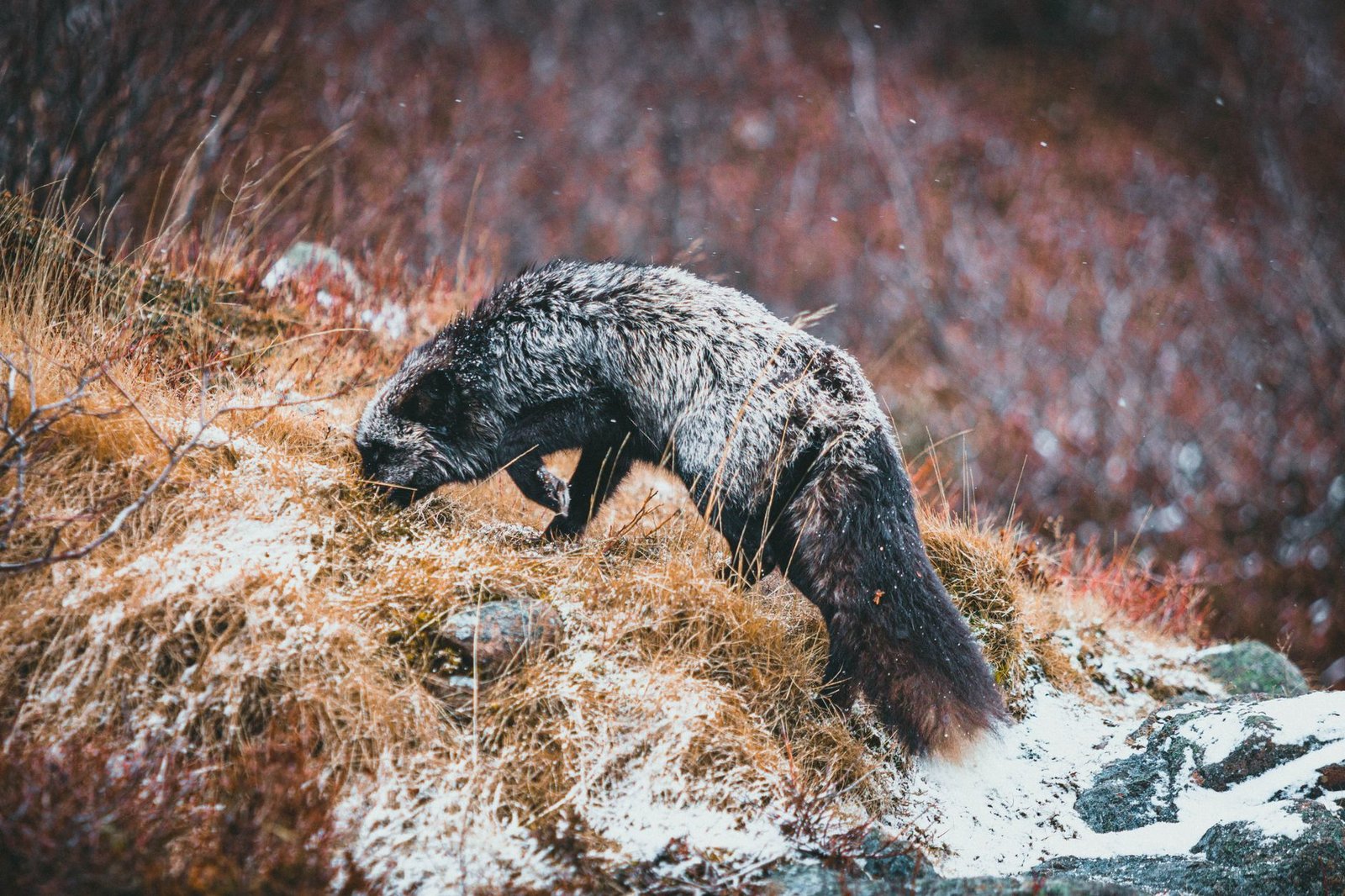
The den is a tunnel in the snow. Somewhere above the tree line in late winter, a female wolverine digs into a drift that may sit over boulders and fallen logs, and gives birth in the dark. Her kits stay hidden there into April and May. If that snow melts too early, the hiding place goes with it, and that is why wolverines and climate change keep showing up in the same sentence.
The answer is split down the middle of the mountain. A team of climate scientists modeled spring snow, slope by slope, in Glacier National Park in Montana and around Rocky Mountain National Park in Colorado. By the middle of this century, snow deep enough for denning is likely to hold on across the upper half of the elevations where wolverines den, in every scenario but the warmest. The lower half is projected to lose a large share of it. The work, led by Joseph Barsugli, appeared Oct. 13, 2020, in the journal Earth’s Future.
That split matters because there are not many wolverines to spare. Statistical modeling puts the population in the lower 48 states at about 318 animals, with a plausible range of 249 to 626, mostly in Washington, Montana, Idaho and Wyoming. That is a thin population spread across a huge amount of rock.
Why wolverines need snow to den
Snow is the nursery wall. The wolverine (Gulo gulo) is the largest member of the weasel family, a relative of the much smaller fisher, which has its own troubles with rat poison turning up in fisher cats across the Northeast. Wolverines breed slowly and live at low densities. For years, biologists have linked their dens to snow that lasts deep into spring. Earlier mapping work drew a “climate envelope” around that snow and projected it would shrink by about a third by 2045 and by two thirds by 2085.
The old maps were blurry. Those projections used grid cells larger than 11 square miles (30 square kilometers), far too coarse to tell one side of a ridge from the other. Here’s the thing: a wolverine does not den in an average. She dens on one slope, at one height, facing one direction. The U.S. Fish and Wildlife Service, weighing whether to list the animal as threatened, had flagged exactly this gap, and its uncertainty about fine-scale snow loss is what started this study.
The new model works pixel by pixel. The researchers ran a physics-based snow model on a grid of 820-foot (250 meters) squares. It tracks the energy hitting the snow, including how much sun each pixel gets as the shadows move through the day and the season. They checked it against snow stations on the ground and against satellite images of snow cover, then ran it for the years 1998 to 2013 and for five versions of the climate around 2055.
Those five versions were picked on purpose to cover the spread of global climate models, from barely 1.5 degrees Fahrenheit (0.8 degrees Celsius) of winter warming to more than 7 F (4 C), and from slightly drier winters to much wetter ones. Earlier work had mostly varied temperature. Precipitation turns out to matter a great deal in the high Rockies.
Wolverines in Glacier National Park and the line on the mountain
Montana’s dens set the bar. The team used 14 known dens in Glacier National Park, found between 2003 and 2007, to decide how much snow counts. On April 15 the median modeled depth at those dens was about 4.3 feet (1.3 meters). By May 15 it was closer to 2 feet (0.6 meters). So the study tracked ground with at least 3.3 feet (1 meter) of snow in mid April and at least 1.6 feet (0.5 meters) in mid May.
Up high, the snow barely flinches. Dens in Glacier sit between roughly 4,900 and 7,500 feet (1,500 and 2,300 meters). Above about 7,200 feet (2,200 meters), the April snow cover hardly changed in the projections. Below about 4,600 feet (1,400 meters), more than half of it disappeared in all but one scenario. The difference between the top and the bottom of the denning band is stark, the authors wrote.
Across the whole Montana area, the loss of deep April snow ranged from 11% in the mildest scenario to 71% in the hottest. The reason the high ground holds is simple. Where winters stay well below freezing, extra snowfall from a wetter climate can cancel out the warming. Lower down, temperature wins. The researchers estimated that shifting the denning band roughly 660 feet (200 meters) uphill would remove much of the risk in four of the five scenarios, if the terrain up there suits a den.
Wolverine reintroduction in Colorado and the snow up high
Colorado has room above the line. No wolverine dens are documented around Rocky Mountain National Park, though the animals have been seen there recently and the area has been discussed as a place to bring them back. The team estimated where dens would sit using 47 known dens across the western states, which put the likely band at about 8,900 to 11,800 feet (2,700 to 3,600 meters).
The Colorado site came out tougher. Deep April snow ranged from an 8% gain to a 26% loss, against the 11% to 71% loss in Montana. Above about 10,500 feet (3,200 meters), losses stayed modest in four of the five scenarios, and by mid May the snow at around 11,200 feet (3,400 meters) largely persisted. The exception was the warm and dry scenario, which stripped almost all the deep snow in dry years. Honestly, that one scenario is the reminder that the forecast for Colorado depends on how much snow falls, not only on how warm it gets.
North facing slopes keep snow longer
Direction counts as much as height. South and southwest facing slopes, which take the full afternoon sun, are projected to lose much more snow than other slopes. In most scenarios the loss on sunny exposures was more than 50% greater. In one Colorado scenario, the gap reached almost three to one. Think of two parked cars on a spring day, one in the sun and one in the shade of a building. Same air, very different dashboards.
That result puts numbers on an older idea from researchers Lundquist and Flint, who suggested in 2006 that north facing slopes would react more slowly to warming and could serve as refuges for snow-dependent species. Only a model fine enough to see individual slopes can show it, which is the main thing this study adds over the earlier, coarser maps.
The snow is a proxy, not the whole story. The paper models snow, not wolverines. Other recent studies, which the authors cite, have documented wolverines denning with little or no lasting spring snow, so deep snow may help without being strictly required. The authors also say plainly that the study does not test whether den sites limit the population, or whether other effects of warming, such as losing the lower snow and the disturbance that follows, will hurt wolverines more. The Colorado den band is an estimate, not an observation. The model also ignores dust on the snow, which speeds melting, and it overestimated snow in Colorado’s two driest years, so future losses in dry years are probably understated.
Taken together, the authors concluded that if spring snow plays a real role in where wolverines den, the findings support conservation efforts through at least mid century, including the potential to bring wolverines back to parts of Colorado. The next test belongs to the animals themselves: whether wolverines move uphill and onto shaded slopes as the low snow thins, and whether those high, north facing pockets are enough to raise kits.
The study at a glance
- Journal: Earth’s Future, October 2020
- Type of study: High resolution computer modeling of spring snow under five future climate scenarios
- Sample: Mountain terrain around Glacier National Park, Montana, and Rocky Mountain National Park, Colorado, mapped in 820-foot (250 meters) squares
- Main finding: By about 2055, spring snow deep enough for dens is likely to persist in the upper half of wolverine denning elevations in all but the warmest scenario, while the lower half loses much of it.
- Limits: Models snow only; it does not show whether snow loss will reduce wolverine numbers.
Source: Joseph J. Barsugli, Andrea J. Ray, Ben Livneh, Candida F. Dewes, Aaron Heldmyer, Imtiaz Rangwala, John M. Guinotte and Stephen Torbit, “Projections of Mountain Snowpack Loss for Wolverine Denning Elevations in the Rocky Mountains,” Earth’s Future, 2020. DOI: 10.1029/2020EF001537.