 Editorial NexoScience
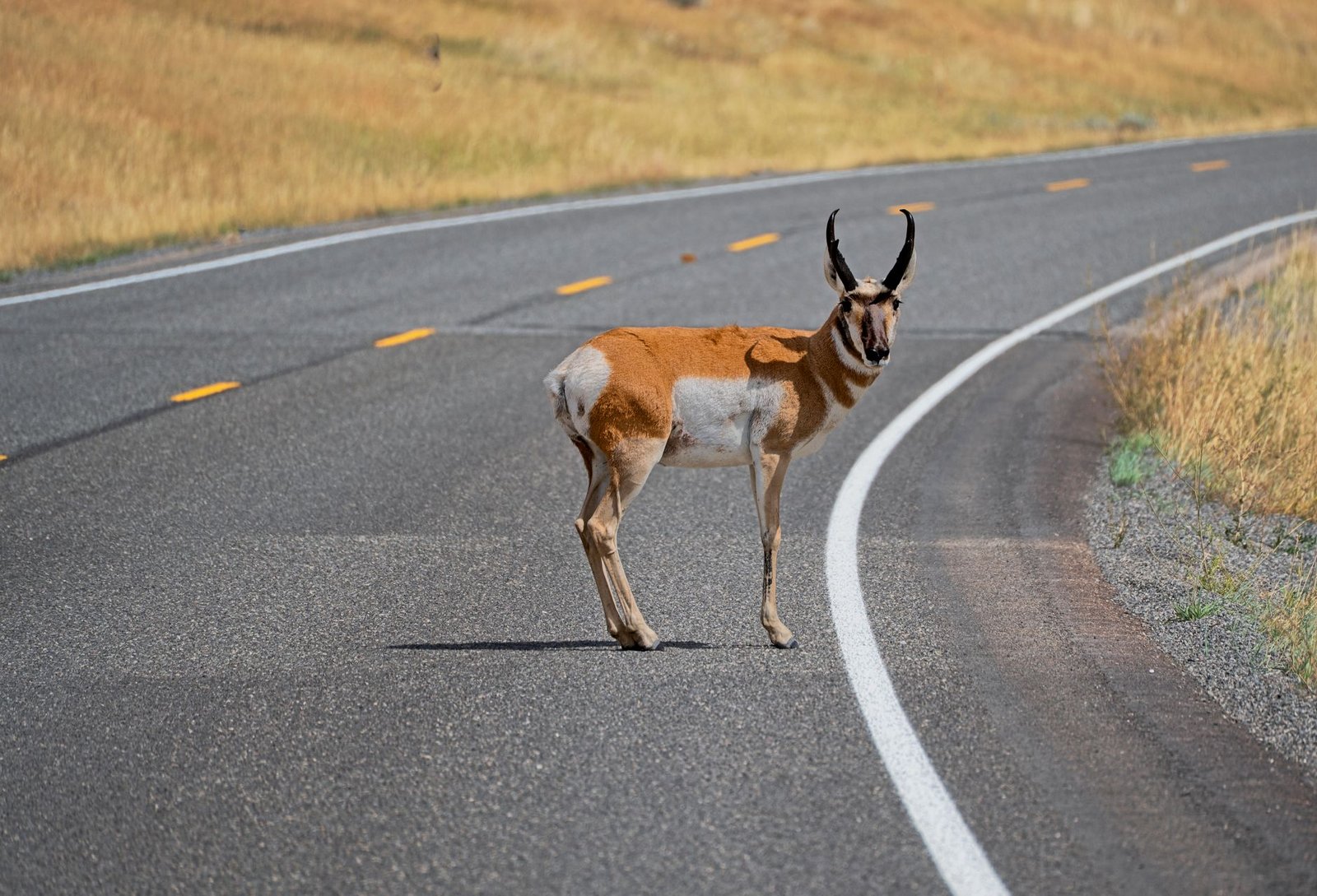
Ears up. Eyes fixed on the concrete. That is how pronghorn walked toward the new wildlife bridge over US Highway 191 in western Wyoming, every time observers watched them do it. The animals had funneled through this same gap in the sagebrush for some 6,000 years. Then, in 2012, the gap got a fence and a bridge.
So did the pronghorn overpass work? Yes, and better each season. Over three years of watching, the herd crossed safely more often as time went on, and once the fences closed, no pronghorn was seen on the asphalt again. Yet the animals did not relax. They spent more of each approach in a tense, locked-on stare after construction ended than while it was still going on, and some got tangled in cattle fences at the ends of the bridge. The overpass kept them off the road long before it earned their trust.
The data came from a spotting scope, not a collar. Most road studies count animals with collars or cameras. This one watched how they acted. The work was led by Renee Seidler of the Wildlife Conservation Society (WCS), with David Green of Oregon State University’s Institute for Natural Resources and Jon Beckmann of WCS, and it was published in 2018 in the journal Global Ecology and Conservation. From fall 2011 to spring 2014, observers sat on hillsides less than half a mile from the overpass during each migration. They picked one animal in a group and followed it for at least three minutes. They noted where it was in the group, how far it was from the road and whether people were nearby. In all, they watched 293 pronghorn (Antilocapra americana) from 154 groups.
Trappers Point and the Path of the Pronghorn
A bottleneck older than the pyramids. Trapper’s Point sits near the town of Pinedale, in the Upper Green River Basin, at about 7,200 feet (2,195 meters). Twice a year, between 1,000 and 2,000 pronghorn squeeze through it, along with thousands of mule deer. Digs at the site show pronghorn have used the route for about 6,000 years. Some 300 to 400 of them keep going north to summer range in Grand Teton National Park, about 93 miles (150 kilometers) away. It is the park’s last remaining pronghorn migration route, and an earlier study in Biology Letters showed how little the corridor has shifted since prehistoric times. In 2008 it became the Pronghorn Migration Corridor, better known as the Path of the Pronghorn.
The highway ran right across the gap. US 191 was a two-lane road with no median. Collisions with hoofed animals during migration averaged 85 a year along a 12-mile (20 kilometer) stretch. A road like that can also keep animals from their ranges and their mates, the slow harm that shows up when wildlife quietly loses its genetic diversity. In 2011 the Wyoming Department of Transportation started building two overpasses and six underpasses, linked by 8-foot (2.4 meter) woven-wire fence. All of it was done in 2012. The Trapper’s Point overpass is a concrete arch 150 feet (46 meters) wide.
For half a century, the road itself was the crossing. Before the fences went up, pronghorn simply walked across the pavement. Of the 95 successful crossings the observers recorded, about a third happened on the asphalt. Nearly three in five went over the overpass, and only one in 25 went through the underpasses. Every crossing on the road surface took place before the structures were finished. A separate study on the same highway, published in the Wildlife Society Bulletin in 2016, had already found that pronghorn favored the overpasses over the underpasses.
How well the wildlife crossings worked for pronghorn
Success climbed, season by season. Pronghorn reached the far side 95 times in 285 attempts, or about one try in three. Each burst of focused approach counted as one try. The odds of a successful crossing rose steadily across the five migration seasons in the study. People nearby, from construction crews to tourists and off-road riders, made no measurable difference.
The stare got longer, not shorter. The researchers sorted behavior into three bins. “Sustained vigilance” meant walking or running straight at the crossing while staring at it with ears erect. “Stress” meant flared rump hair, head-bobbing or pacing along a fence. Everything else counted as normal behavior. Over time, vigilance went up, stress stayed flat, and normal behavior shrank. Even 20 months after construction ended, the herd still walked in on high alert.
The leaders did most of the worrying. Animals at the front of a group spent more time in that locked-on stare than the ones behind them. Pronghorn groups tend to copy their lead animal, so the leader is, in effect, deciding for everyone. And group identity explained about a quarter of the differences in crossing success. Something about each group, whether its makeup, its size or its leader, mattered in ways the study could not pin down.
Safer is not the same as familiar. Here’s the thing. The overpass made the crossing far safer, yet the animals seemed to miss the old, deadlier one. The authors call this possible maladaptation, a habit that no longer fits the risk. After decades of practice, pronghorn were more at ease on the road surface, cars and all. Picture a commuter whose usual shortcut is suddenly closed. The new route is safer and it works, but for months they drive it with both hands on the wheel.
Cattle fences and gates at the pronghorn overpass
The worst moments happened at the wire. Head-bobbing and pacing showed up only along fence lines, as animals looked for a way past. Both ends of the overpass had a cattle fence with a smooth bottom wire 16 inches (41 centimeters) off the ground, two barbed wires and a wooden top rail. Each fence had a gate, but someone had to open and close it by hand every season. The observers sometimes saw nervous pronghorn tangle themselves in the wire when a gate was shut, could not be found, or was lying on the ground. Snow made it worse.
A few inches of wire would help. The fences are there for a reason: a seasonal cattle drive passes through the same bottleneck. So the authors proposed fixes that work for both cows and pronghorn. They include removable or lay-down fencing, or raising the bottom wire to 18 to 20 inches, swapping barbed wire for smooth wire and taking off the wooden rail. Pronghorn usually duck under a fence rather than jump it. Where cattle are absent, even clipping the bottom wire up to the middle one gives them room to pass.
The fences went up before the bridges were ready. Several stretches of barrier fence were finished before the crossings opened, which can trap animals on the road during construction. The authors’ fix is about scheduling. Transportation agencies should give each contractor a set order for finishing fences and crossings, instead of separate landmark dates. Wyoming did pause major work on the overpass during migrations, and that likely spared the herd a lot of stress.
What the Wyoming pronghorn study could not measure
The view was partial. The models explained about a quarter of the variation in vigilance and almost none of it in stress behaviors. Hilly ground near the structures hid many animals once they got close, so the most stressful moments were the hardest to record. The analysis also used only the first three to five minutes of each watch, often well away from the fence. The authors noted that their stress category may have been too narrow, since the locked-on stare itself could count as a milder form of stress. And the study tracked behavior, not survival or the number of fawns, so it can’t say whether all that vigilance costs the herd anything.
Still, the authors call it a conservation success. Pronghorn here have to migrate to survive the winters, and that strong drive likely helped them adapt to the bridge. The team suggested coming back once the herd had more time to settle in, and testing whether other species react the same way at other sites. The question left hanging is a simple one. How many trips does it take before a bridge stops looking like a threat to an animal that crosses it only twice a year?
The study at a glance
- Journal: Global Ecology and Conservation, July 2018
- Type of study: Field observations of migrating pronghorn behavior at new highway crossing structures, during and after construction
- Sample: 293 pronghorn from 154 groups at the Trapper’s Point overpass and two underpasses on US 191, Wyoming, from 2011 to 2014
- Main finding: Successful crossings rose each season and pronghorn stopped using the road surface, but the time they spent in tense vigilance also rose after construction.
- Limits: Small sample, partial view near the structures, and no measure of survival or reproduction.
Source: Seidler, R. G., Green, D. S., & Beckmann, J. P. (2018). “Highways, crossing structures and risk: Behaviors of Greater Yellowstone pronghorn elucidate efficacy of road mitigation.” Global Ecology and Conservation, 15, e00416. https://doi.org/10.1016/j.gecco.2018.e00416