 Editorial NexoScience
A raw chicken egg in a wire-mesh trap. That was the bait crews set along the canals at the edge of Everglades National Park, and on ranch land in Charlotte County, to catch Argentine black and white tegus. The lizards came for the egg. What they had eaten before they got there turned out to be the more useful part.
So what do tegus eat in Florida? Almost anything they can crush, chew or tear apart. Biologists at the University of Florida sorted the gut contents of 275 invasive tegus and found insects in nearly all of them and mammals in four out of five, along with frogs, snakes, turtles, birds, eggs, snails and fruit. In their native South America, fewer than half of the tegus checked in earlier studies had eaten an animal with a backbone. In Florida, nearly nine in ten had.
The menu came out of hundreds of stomachs. The work was led by Madison Harman, of the University of Florida’s Department of Wildlife Ecology and Conservation, with scientists from the U.S. Geological Survey (USGS) and the National Park Service. It was published in September 2025 in the journal Frontiers in Amphibian and Reptile Science. The tegus were trapped and euthanized between 2016 and 2021 as part of control programs. Most came from Miami-Dade County, where the lizards have been established since about 2011. The rest came from Charlotte County, where a younger population took hold by 2018. The authors describe it as the largest tegu diet study to date.
Argentine tegus in Florida and where they came from
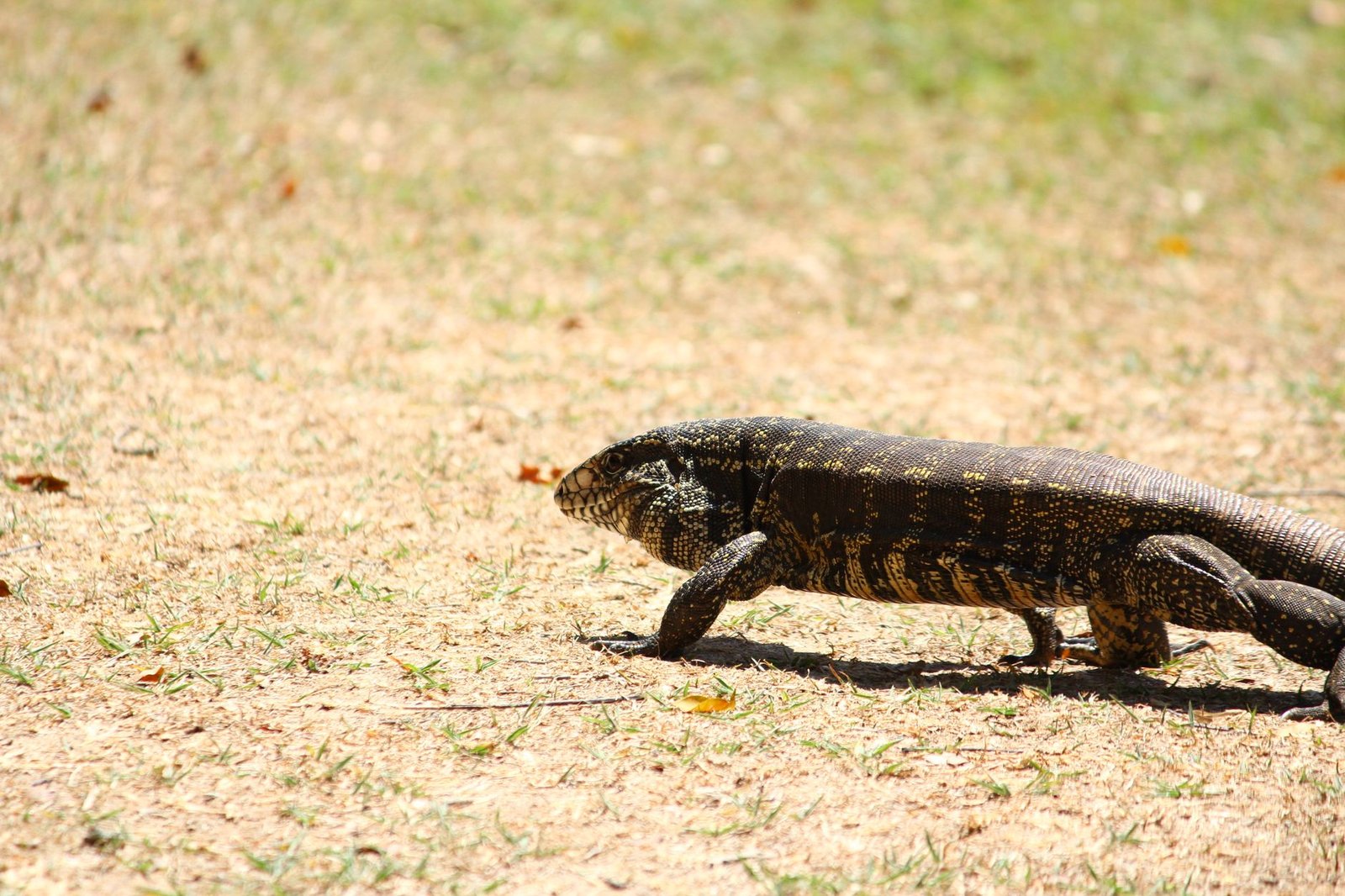
A pet that got loose, more than once. The Argentine black and white tegu (Salvator merianae) is a big, clever lizard from South America. Adults reach nearly 20 inches (half a meter) from snout to vent, before you even count the tail. They mature in about three years, can live for 20 and lay clutches of roughly 30 eggs. Their brains and calm temper made them popular as pets, and Florida sits at the center of the live reptile trade. Tegu sightings in the state began in 2006. By 2024 there were reports from 40 counties and four established populations: Hillsborough and Polk counties, Miami-Dade, Charlotte and, the newest, St. Lucie.
Florida has seen this story before. Escaped and released reptiles have built wild populations all over the state, and the Burmese python is only the most famous. Animals that people turn loose can go wild far from Florida too, as the wild horses of Theodore Roosevelt National Park show. With tegus, the worry is the package. Lots of eggs. A diet with few limits. A tolerance for very different habitats. Put together, those traits point to an animal that adapts fast and shrugs off removal efforts.
Picking through the leftovers. Tegus chew and crush their food, and digestive juices do the rest, so most of what the team found came in fragments. Each gut sample was rinsed through three nested sieves. Then the pieces went under a microscope: hair and feathers, scales, teeth, beetle shells, snail shells and seeds. Experts from the Florida Museum of Natural History, the Smithsonian and other institutions helped name the hardest bits. On average, each tegu held more than a dozen different foods. Think of a detective reading a shredded grocery receipt. You can tell what was bought, but rarely how much.
How often tegus eat eggs, rabbits and turtles
Mammals topped the list of prey with backbones. Rodents showed up in about half of all tegus. Frogs and toads turned up in more than a third, and lizards, snakes and reptile eggs in roughly one in five each. Among prey intact enough to name were long-lived natives such as the Florida box turtle (Terrapene carolina bauri), the striped mud turtle and the American eel. The tegus also ate plenty of other invaders, including black rats, house mice, Cuban treefrogs, cane toads and brown anoles.
Eggs were undercounted, on purpose. Tegus do eat eggs. Reptile eggs turned up in about one in five tegus and bird eggs in about one in six, but the real share is likely higher. Because the traps were baited with chicken eggs, the team threw out any shell that looked like chicken. That could also have erased eggs of large ground-nesting birds such as Muscovy ducks. A study in Brazil that watched tegus feed also saw them crack big eggs and lap up only the insides, which leaves little shell for anyone to find in a gut. Earlier work in Florida had already caught tegus raiding American alligator nests.
Two populations, two menus. Charlotte County tegus ate more rabbits, birds, snakes and bird eggs. Of the 35 tegus that had eaten a rabbit, 33 came from Charlotte. Miami-Dade tegus ate more snails, turtles and frogs. Snails were in about three of every four Miami-Dade tegus, against one in six from Charlotte. Nearly every snail that could be identified belonged to a single species, another invader called the Cuban garden zachrysia.
Pythons may explain part of the gap. In Miami-Dade, tegus share their range with Burmese pythons, which have been eating mammals, wading birds and even alligators in the Everglades for decades. Charlotte County lies just north of where the pythons are established, so its prey is likely more intact. That’s why the authors think the Charlotte diet may be the better preview of what tegus would eat if they reached somewhere new.
Toxic food didn’t slow them down. Tegus ate eastern lubber grasshoppers (Romalea microptera), big, slow insects that defend themselves with foul chemicals. The lubber was the single most common insect species in the whole study, found in about two in five tegus. They also ate Cuban treefrogs and cane toads, whose skin makes many predators sick. Guts held carrion as well, judging by the maggots, fly pupae and carrion beetles. Some held fertilizer beads and bits of foam. A few held other tegus. And nearly every lizard looked healthy at necropsy, the animal version of an autopsy.
Spring is for meat, fall is for fruit. Time of year was the best single predictor of what a tegu had eaten. Tegus spend up to six months of the cool season in brumation, a reptile’s version of hibernation. They wake in spring to feed and breed. Spring stomachs held more young rabbits, birds, snakes and lizards, plus bird and reptile eggs. By late summer and fall, diets leaned on ripe fruit, grasshoppers and other insects. Size mattered too. Bigger tegus ate a wider range of food, with more vertebrates and snails, while smaller ones relied more on fruit and grasshoppers.
Why tegus are dangerous to native wildlife
The real fear is for rare animals. Florida’s wildlife agency restricts owning and moving tegus because of the threat they pose to native wildlife and crops. Species such as the American crocodile, the eastern indigo snake, the Cape Sable seaside sparrow and the gopher tortoise live or nest on the ground, and earlier studies caught tegus eating young gopher tortoises. None of these rare species was common where the study’s tegus were trapped. Still, the team found bird and reptile eggs, young turtles and small songbirds such as the common yellowthroat and gray catbird. Honestly, a lizard that eats rabbits this often is not what most people picture.
The Florida Keys would be an easy buffet. Half of all tegus had eaten at least one rodent, and over half of the Charlotte tegus had eaten a rabbit. The Keys are home to the endangered Key Largo woodrat, the Key Largo cotton mouse and the Lower Keys marsh rabbit. Marsh rabbits raise their young in nests above ground, where the babies stay exposed until they can fend for themselves. Burrows offer little shelter either. Shrews and moles showed up in tegus from both populations, and tegus have been seen digging up a mole.
Seeds may ride along in tegu droppings. The guts held fruit from at least 26 kinds of plants, from native figs and coco plums to squash and grapes from nearby farms. Several Miami-Dade tegus ate seeds of the Florida royal palm, which the state’s agriculture department lists as endangered. Tegus also swallowed seeds of invasive plants such as balsam pear and Brazilian peppertree. In South America, tegus are known seed spreaders that can even help seeds sprout. In Florida, nobody knows yet whether they are planting natives, invaders or both.
How far north tegus could survive and spread
Cold may not stop them. Freezes hold back many invasive reptiles in Florida, but earlier research cited by the authors suggests tegus may not be limited that way. A suspected breeding population turned up in two Georgia counties in 2018. Range models suggest tegus could survive across much of the southeastern United States, with more room to spread as the climate warms. You know what makes that worse? A diet like this one. An animal that eats nearly everything rarely runs out of food in a new place.
What the gut contents can’t show. The study records what tegus ate, not how much, and not what that does to prey populations. The team scored each food as simply present or absent, because chewing and digestion left too little to count. Soft prey such as caterpillars digests faster than beetles or turtle shell, so some foods are likely missing. Most tegus examined were adults longer than 11 inches (28 centimeters) from snout to vent, so the diet of young tegus may differ more than the data show. The researchers also noted that their subset may not fully match the wider populations. Month and size were real predictors, yet they explained only a small share of the differences between one tegu and the next. And a gut full of royal palm seeds does not prove that a tegu ever planted a palm.
Speed beats everything else. The authors conclude that the breadth of the tegu diet backs up removal efforts and, above all, early detection and fast response wherever a new population appears. A lizard that does fine on farm edges, in pine rockland and in sawgrass marsh is hard to wipe out once it settles in. The question the team leaves open is the one the seeds raise: whether Florida’s tegus are quietly changing which plants grow where.
The study at a glance
- Journal: Frontiers in Amphibian and Reptile Science, September 2025
- Type of study: Gut content analysis of invasive tegus removed by control programs, with statistics on season, size and habitat
- Sample: 275 Argentine black and white tegus trapped in Miami-Dade and Charlotte counties, Florida, between 2016 and 2021
- Main finding: Florida tegus ate insects, mammals, fruit and snails most often, and ate vertebrates far more often than tegus in South America, with diets shifting by month and body size.
- Limits: Records only whether each food was present, mostly in adult tegus, and does not measure the effect on prey populations.
Source: Harman, M. E. A., Fuller, N. R., Baiser, B., Blackburn, J. K., Li, X., Currylow, A. F., Yackel Adams, A. A., Falk, B. G., & Romagosa, C. M. (2025). “Dietary breadth and ecological plasticity facilitate invasion potential in a large omnivorous lizard.” Frontiers in Amphibian and Reptile Science, 3, 1635085. https://doi.org/10.3389/famrs.2025.1635085