 Editorial NexoScience
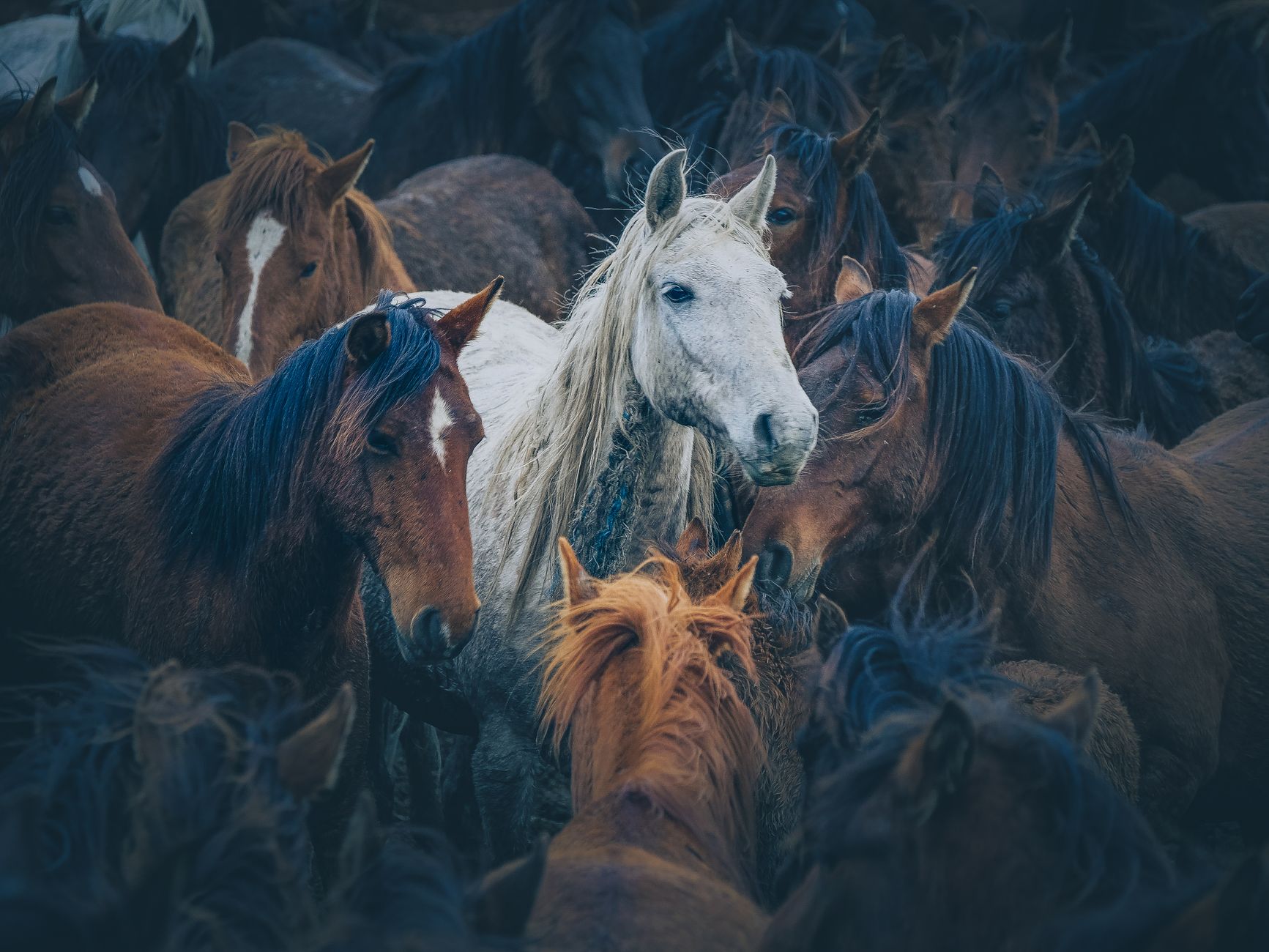
In 1883, a businessman in Medora, North Dakota, bought 250 horses that had been confiscated from the Lakota Sioux at Fort Buford. Some of them were turned loose in the badlands to breed. Then the trail goes cold. For more than a century, nobody could say for sure where the wild horses of Theodore Roosevelt National Park came from.
Their DNA gives a partial answer. A genetic survey of almost the whole herd found that the Theodore Roosevelt National Park wild horses descend from a mix of domestic breeds and from at least two separate maternal sources. Most of the herd’s mothers trace back to a lineage that is common in the Americas. One line, though, has its closest known relatives in China and Siberia. The exact origin is still unknown, and the herd turned out to have less genetic variety than most of the feral herds and breeds it was compared with.
A roundup turned into a DNA census. The work was led by Igor Ovchinnikov, a biologist at the University of North Dakota, with staff from the park and geneticists from Texas A&M University. It was published Aug. 1, 2018, in the journal PLOS ONE. During a 2013 roundup, the team collected mane and tail hair, roots attached, from 196 horses. The park held 214 horses at the time, so the sample was close to a full head count.
Where the wild horses in North Dakota came from
Spanish ships, tribal trade and ranch stock. Horses (Equus caballus) died out in the Americas about 10,000 years ago and came back in the 1500s with Spanish conquistadors. By the mid-1700s they were part of many Native American cultures on the Great Plains. The Mandan, Hidatsa and Arikara villages on the Missouri and Knife rivers ran busy horse markets until at least 1850. Then came the ranchers. Ranch horses were often left to roam free, and fresh stock kept arriving by railroad and with cattle drives along the Great Western Cattle Trail. Tribal ponies and ranch horses most likely mixed out on the range.
The herd nearly blinked out. Little is known about the horses between the early 1900s and 1947, when the park was set up. By 1966, only 16 animals were thought to remain, a herd that would fit in a couple of livestock trailers. The park let it grow back, using roundups and auctions to keep numbers in line with the grass. In the 1980s it added several stallions to freshen the bloodline, among them an Arabian, a Shire and Paint cross, a Quarter Horse and three horses from the Bureau of Land Management (BLM). A few stray horses may also have slipped in, even though the park boundary has been fenced since 1956.
Wild or feral horses: what the park herd is
Wild in their habits, domestic in their roots. Scientists call the horses in Theodore Roosevelt National Park feral. That means they descend from domestic horses that went back to living on their own. In that sense the park’s couple of hundred horses are a tiny slice of the roughly 77,000 feral horses that roam public lands in ten Western states. Here’s the thing, though. “Feral” says nothing about which breeds went into a herd. That was the question the DNA had to answer.
Two kinds of DNA, two kinds of clue. The team read two genetic records. Mitochondrial DNA (mtDNA) is a small loop of genes that passes only from mother to foal, so it tracks the female line back through time. Short tandem repeats are stretches of DNA where a short code repeats like a stutter. They come from both parents and show how varied a group is today. The team checked 12 of these markers and compared the park horses with dozens of breeds and other feral herds in a database kept at Texas A&M.
What genetics reveals about the Theodore Roosevelt horses
Three mothers’ lines, and an odd one out. The team read the mtDNA of 187 horses, and every one carried one of just three versions. Two of them, which the team named L1 and L2, are near twins. They belong to a family of lineages called haplogroup L and showed up in 156 horses, about five in every six. Haplogroup L is common in Europe and even more common in the Americas, likely because early European settlers brought it over. The third version, from haplogroup B, turned up in the other 31 horses, all from four family groups.
The full genomes told a sharper story. A short stretch of mtDNA wasn’t enough to place the herd on the horse family tree. So the team read the complete mitochondrial genome of one horse from each line. None of the three matched anything in GenBank, the public library of DNA sequences. The two L genomes came closest to an American Paint horse, and in one case the gap was a single missing letter. The B genome had no close match at all. Its nearest known relative was a Thoroughbred racehorse from China, six letter swaps and four small deletions away. Next came an Italian horse, a Yunnan horse from China and a Yakutian horse from central Siberia.
An Asian link nobody saw coming. You know what makes this odd? Those relatives hint that some horses may have reached North America from Siberia and East Asia, not only from Europe. The authors called it an exciting hypothesis but noted that records of horses arriving with Russian and Chinese explorers and merchants are thin. They also offered a plainer reason: horse mtDNA from Europe and North America is poorly sampled, so the Asian match may only reflect holes in the database. The nuclear DNA didn’t back the Siberian link either. A Yakut horse was in the comparison and looked nothing like the park herd.
The nuclear DNA points to a melting pot. The 12 markers set the park horses apart from 48 major breeds. On one family tree they paired with the Garrano, a semi-feral breed from Portugal. A second analysis showed that link was loose, and the Garrano never contributed much to North American horses anyway. Every gene variant the team found was already known from domestic horses. The likeliest story, the researchers wrote, is a herd of mixed domestic breeds that lost much of its variety when its numbers crashed. Its two maternal lines split about 90,000 years ago, long before horses were tamed, so the herd has at least two separate maternal roots.
Why the herd’s low genetic diversity worries scientists
Less variety than nearly every herd it was measured against. The park horses came up short by both measures. Heterozygosity is roughly the share of genes where a horse got two different versions from its parents. The park herd scored 0.621, against 0.716 for the average feral herd and 0.710 for the average domestic breed. The few breeds that score that low tend to be very small or heavily inbred. On the mtDNA side, the herd beat only the horses of Sable Island in Canada among the herds it was compared with.
A bottleneck leaves a mark. Think of a herd’s genes as a deck of cards. When only 16 horses were left in the 1960s, most of the deck was thrown away, and a handful of new stallions couldn’t rebuild it. The authors tie the low diversity to that crash and to the few horses added since. Earlier tests of the herd, in the 1990s and in 2000, had already caught variety slipping away through inbreeding and chance. Small, closed groups of animals tend to lose variety this way, which is part of why wildlife is quietly losing its genetic diversity in many places.
The origin story is still open. The researchers said plainly that their effort to pin down the herd’s origins did not succeed. The short mtDNA stretch has too few useful sites, the full genomes cover only three horses, and 12 nuclear markers can’t sort out breeds after a herd has been through bottlenecks and inbreeding. The Asian link rests on a single maternal line and on public databases that are thin for North American and European horses. The study also doesn’t show that low diversity is harming these horses today. It shows a higher risk of the health problems that inbreeding can bring.
The fix the authors suggest is new blood. They recommend bringing new horses into the park, ideally mares that are not already pregnant, since earlier tries with stallions gave tepid results and a mare is sure to pass on her genes. Repeated introductions could let a small herd of fewer than 90 horses, the size the park’s grazing plan allows, hold more variety than today’s closed herd. Culling should also protect the existing maternal lines. Next, the team wants denser genetic tests and samples from horses in Siberia and China. That’s the only way to learn whether the badlands really hide a link to Asia.
The study at a glance
- Journal: PLOS ONE, August 2018
- Type of study: Genetic survey of a feral horse herd using mitochondrial DNA and 12 nuclear DNA markers
- Sample: Hair from 196 of the 214 horses living in Theodore Roosevelt National Park in 2013
- Main finding: The herd comes from mixed domestic breeds and at least two maternal sources, one closest to horses from China and Siberia, and its genetic diversity is below most feral herds and breeds.
- Limits: Existing genetic databases were too thin to pin down the herd’s exact origin.
Source: Ovchinnikov, I. V., Dahms, T., Herauf, B., McCann, B., Juras, R., Castaneda, C., & Cothran, E. G. (2018). “Genetic diversity and origin of the feral horses in Theodore Roosevelt National Park.” PLOS ONE, 13(8), e0200795. https://doi.org/10.1371/journal.pone.0200795