 Editorial NexoScience
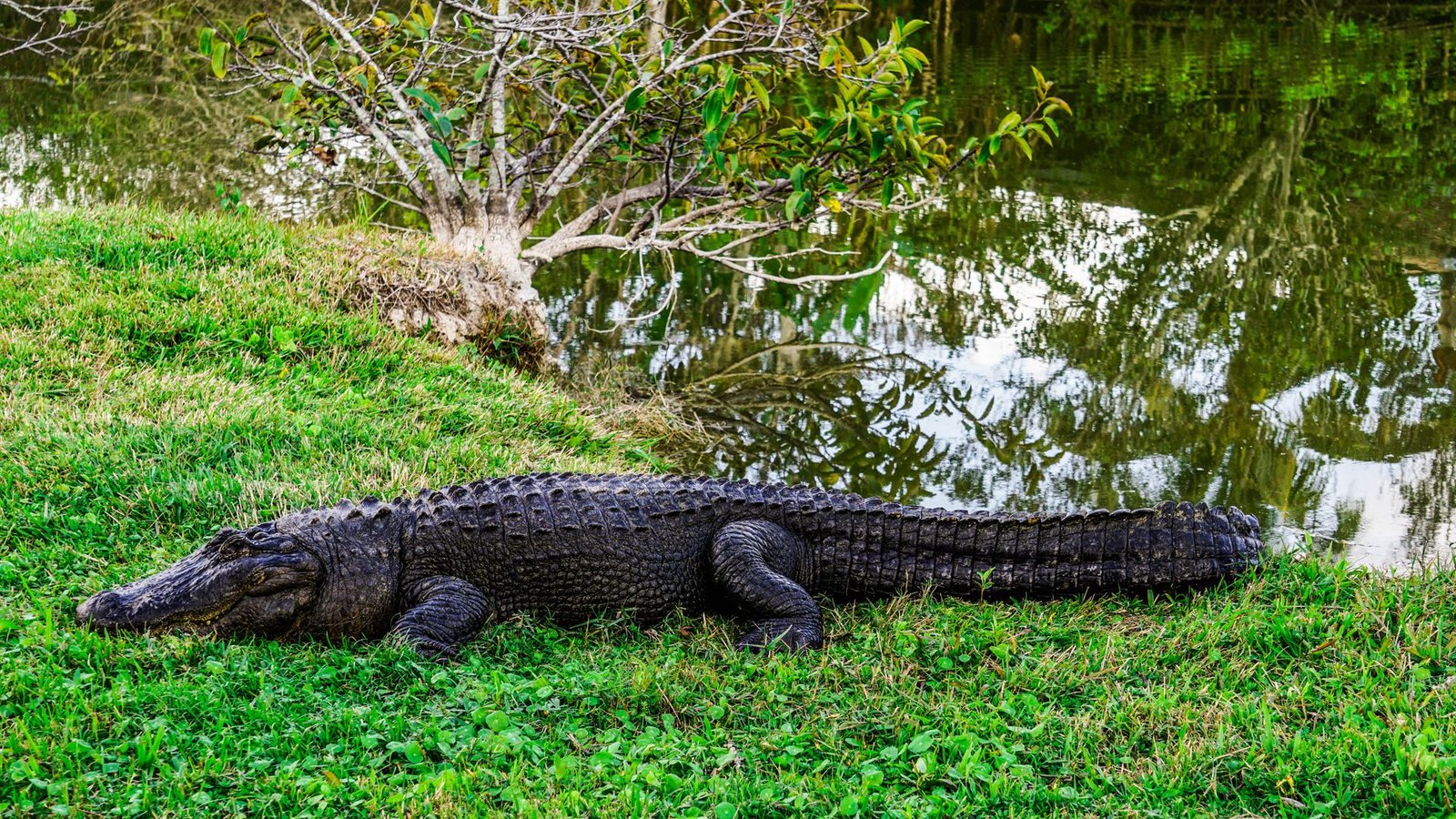
The tools are almost comically ordinary. A spotlight sweeps an Everglades marsh after dark, two eyes glow back, and a few minutes later someone is wrapping a flexible sewing tape around the chest of a wild alligator. Then comes a hanging spring scale. Biologists from the University of Florida and the U.S. Fish and Wildlife Service repeated that routine on 5,508 alligators between 1999 and 2022.
So how much does an alligator weigh? Far more than its length lets on, because weight climbs faster than size. Run the team’s average curve for the Everglades and a 6-foot (1.8 meters) alligator comes out near 37 pounds (17 kilograms), while a 10-footer (3 meters) lands close to 190 pounds (87 kilograms). That’s five times the weight for less than twice the length. The catch is that the curve itself shifts from one corner of the Everglades to another, and that shift turns out to be the most useful part of the study.
Twenty-two years of tape and scale. The work was led by Sergio Balaguera-Reina, a wildlife ecologist at the University of Florida’s Fort Lauderdale Research and Education Center, with Frank Mazzotti and colleagues. It was published March 13, 2024, in the journal Scientific Reports. Crews went out at night by airboat or motorboat, caught each American alligator (Alligator mississippiensis) by hand, tongs or snare, tagged it, measured it, sexed it, weighed it and let it go where it was found.
How big alligators get in the Everglades
From hatchling to bruiser. The smallest animal in the data set was about a foot long (30.2 centimeters). The biggest stretched to roughly 11.7 feet (356.5 centimeters). Most were not small, though. About nine in 10 measured more than 4 feet (125 centimeters), because survey protocols shifted over the years toward subadults and adults. The split between the sexes was almost even, with 2,670 females and 2,771 males.
The proportions are steady. On average, an Everglades alligator’s total length was about twice its snout-to-vent length (the body from nose tip to the vent, without the tail) and about seven times the length of its head. Those ratios held across sizes. A gator’s head, body and tail grow roughly in step, which the authors call isometry, meaning a trait keeps the same proportion to the whole body as the animal grows.
Why alligator weight grows faster than length
Bulk is another story. Let me explain with a photocopier. If you enlarged a toy alligator to twice its length, keeping its exact shape, it would get twice as wide and twice as tall too, so it would weigh eight times as much. Real alligators beat that. In the study, weight rose with total length to the power of 3.23 instead of the 3.0 a perfect copy would show. Doubling the length meant roughly nine times the weight, not eight. Tail, chest and neck girth also grew faster than length did.
Big gators bank fat. The authors link that extra bulk to fat and muscle. Growth and metabolism slow as an alligator ages, so a large animal that keeps finding prey can pack on weight faster than it adds length. Eight of the 11 body relationships the team tested showed this kind of faster-than-proportional growth, and the fits were tight, explaining at least 92% of the variation in the data.
Estimating alligator length from its head
The head is the field biologist’s ruler. In murky or weedy water, a survey crew often sees only a head. Biologists then estimate total length from head length, and the same trick works on drone photos or on alligators that have lost part of their tail. It relies on the head keeping a fixed share of the body. That fits a generalist predator that tackles bigger prey as it grows. The spectacled caiman (Caiman crocodilus) shows the same steady head scaling, while the narrow-snouted false gharial (Tomistoma schlegelii), a fish specialist, grows a proportionally smaller head as it gets bigger.
Males and females drift apart at the ends. Alligator sexes were thought to differ mainly in overall length, with males growing longer. Here, small females had slightly larger heads for their size than small males, and the relationship flipped as the animals grew, so big males ended up with slightly larger heads. The gap showed most in gators under about 3 feet (90 centimeters) and over about 5 feet (148 centimeters). Head-based length estimates, the researchers wrote, will be most accurate for mid-size animals and can be off at either end depending on sex.
What skinny Everglades alligators say about the water
One refuge broke the pattern. Honestly, the sex difference was the smaller surprise. Alligators from the Arthur R. Marshall Loxahatchee National Wildlife Refuge, a marsh walled in by levees and canals in Palm Beach County, didn’t scale like the rest. Their weight rose with length at a power of 3.15, against 3.22 to 3.26 in every other area sampled. In practice, young gators in the refuge were slightly heavy for their length compared with young gators in Big Cypress National Preserve, and big ones were lighter than their Big Cypress peers.
Habitat leaves a mark too. Small alligators in rivers were heavier and thicker in the tail for their length than small marsh gators, and the order reversed among the big ones. The authors expected weight to vary, since it tracks how much and how well an animal eats. They didn’t expect head and tail proportions to shift from place to place. Allometry, the way body parts scale with overall size, usually changes very slowly over evolutionary time.
A body condition score is only as good as its curve. This matters for managers. Everglades restoration uses alligators as a living gauge of water and food. A fat gator for its length suggests good conditions, a lean one suggests trouble. Those scores often assume one weight curve fits everywhere, and the Loxahatchee data show it doesn’t. Restoration means putting water back where drainage took it, the same move researchers track when they bring a drained wetland back to life, and alligators are one way to read whether it worked. The team adds a gentler tool: tail girth tracked weight closely, and a tape around the tail is far easier than hoisting a gator heavier than 110 pounds (50 kilograms) onto a scale.
The Everglades is not a neutral lab. The study can’t say why the refuge alligators differ. The authors point to almost two centuries of drainage, canals and water control, which have changed alligator numbers, breeding and prey, but they frame that as a hypothesis, not a finding. All the animals came from one heavily altered ecosystem, sampling effort was uneven across areas, and chest and neck girth were measured on fewer than 500 animals. The design also compares many alligators at one moment each rather than following individuals as they grow. Earlier alligator studies mostly used raw measurements instead of the log-scale math used here, so their numbers can’t be lined up directly.
Next stop, the rest of the range. The researchers want the same measurements repeated in Texas, Louisiana, Alabama, Georgia and the Carolinas, and in wetlands less touched by people. If wild alligators far from the canals show one steady weight curve, the Everglades differences would point to the water. If they don’t, the variation may simply be how alligators are built.
The study at a glance
- Journal: Scientific Reports, March 2024
- Type of study: Field measurements of wild alligators caught in night surveys over 22 years
- Sample: 5,508 American alligators from six areas of the Greater Everglades, South Florida
- Main finding: Alligator weight rises faster than length, about ninefold when length doubles, and that weight curve differs between areas, with Loxahatchee refuge gators standing apart.
- Limits: One heavily altered ecosystem; the link between the differences and water management is a hypothesis.
Source: Balaguera-Reina, S. A., Mason, B. M., Brandt, L. A., Hernandez, N. D., Daykin, B. L., McCaffrey, K. R., Godfrey, S. T., & Mazzotti, F. J. (2024). “Ecological implications of allometric relationships in American alligators (Alligator mississippiensis).” Scientific Reports, 14, 6140. https://doi.org/10.1038/s41598-024-56798-5