 Editorial NexoScience
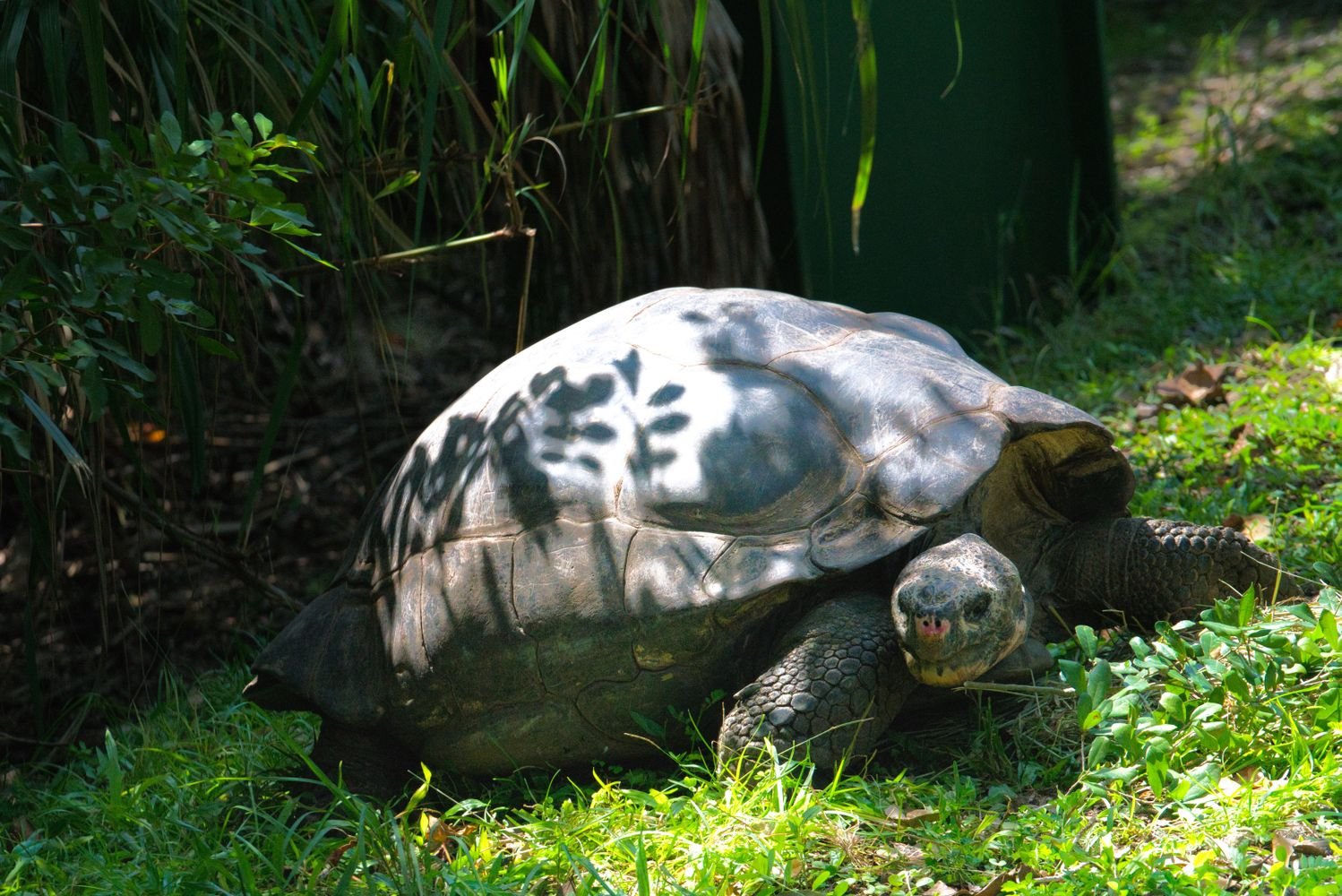
To get a DNA sample from the oldest land animal on Earth, a researcher had to pretend to feed him. Jonathan would start biting the air. That was the moment. One gloved hand wedged his mouth open while the other scraped under his tongue, early in the morning, so bits of plant wouldn’t spoil the sample.
Those scrapes now help explain how Jonathan the tortoise has reached an estimated 194 years, roughly a century past the usual limit for his kind. His genome carries rare variants in genes for DNA repair, telomeres, insulin and cancer control. The bigger clue is chemical. In the promoters of genes that run his mitochondria and process RNA, Jonathan has kept the tidy, quiet pattern seen in young tortoises, while two older adults have lost it. The work, by a team that includes first author Benjamin Vaisvil, was published Oct. 7 in the journal Science Advances.
Jonathan the tortoise’s age and what kind of tortoise he is
He’s older than the lightbulb. Jonathan is an Aldabra giant tortoise (Aldabrachelys gigantea), one of the giant island tortoises from the Seychelles in the Indian Ocean. He arrived on St. Helena, a British territory in the South Atlantic, about 144 years ago, already fully grown, and has lived at the governor’s residence ever since. He’s on the back of the island’s five-pence coin. In June, an online hoax claimed he had died. He hadn’t, and in October he was still very much alive.
A century past the usual ceiling. Aldabra tortoises are famous for long lives, but not this long. A survival analysis of zoo records, cited by the authors, put the average total life expectancy of male Aldabras at about 80 years and the upper limit at about 94. Jonathan sits roughly 100 years beyond that ceiling. Study co-author Justin Gerlach, a biologist at the University of Cambridge, put it this way in a statement: “you get a sense of the tortoise being your collaborator, not your study subject.”
His family tree has a missing branch. The team compared Jonathan’s DNA with that of 30 tortoises from the Aldabra atoll. He lands near the Grande Terre island group, but farther out than other zoo animals with known roots there. One clustering test gave him a genetic share from an unknown source. The authors think he was probably taken from Aldabra long ago, since sailors had likely wiped out the tortoises of the granite Seychelles islands by the early 1800s.
Jonathan the tortoise’s genetics and longevity
No blood, so a stand-in. St. Helena officials wouldn’t allow a blood draw, to rule out any risk of infection. That ruled out the best sequencing methods for Jonathan himself. So the team built a high-quality reference genome from Tank, a 36-year-old Aldabra living in captivity, and lined Jonathan’s shorter DNA reads up against it. The result was a full genome for Jonathan with about 6.9 million differences from Tank’s.
Hundreds of genes changed in ways nobody else shares. Against Tank, the Galápagos tortoise Lonesome George (Chelonoidis abingdonii) and humans, Jonathan had protein-changing variants in 287 genes that appeared in him alone. Four protein language models, AI programs trained on millions of protein sequences, flagged 41 of those as likely to matter. Twelve sit in databases of aging genes. They include POT1, which caps the ends of chromosomes, FOXO3 and ERCC1. Variants in those same three genes have been linked to long life in the immortal jellyfish, in people from Okinawa and in bowhead whales.
Extra copies of a cancer-hunting gene. Jonathan carries 10 copies of the perforin gene, against 7 in Lonesome George. Perforin is the protein immune killer cells use to punch holes in their targets, and mice without it pile up worn-out cells as they age. More copies could help him clear old and cancerous cells, the authors suggest. He also has a duplicated LAMTOR4, a gene that helps control mTOR, a growth pathway tied to aging in many animals. The extra copy carries changes predicted to partly dampen it.
What the longevity study found in Jonathan’s epigenome
Think of methylation as sticky notes on DNA. The epigenome is the layer of chemical tags that tells genes when to switch on and off. The main tag, called methylation, works like sticky notes on a recipe book: the book stays the same, but the notes decide which pages get used. The team read these notes in mouth cells from Jonathan and four other Aldabras, a 5-year-old called Hatch, a 12-year-old called Smalls, and two males, Toka and Poka, who were already adults in 1969.
Disorder creeps in with age. Jonathan had less methylation overall than the juvenile, the same pattern seen when human centenarians are compared with newborns. Over time the notes also get scrambled, a kind of disorder scientists call methylation entropy. Across the five tortoises, age predicted each animal’s average disorder almost perfectly. Jonathan was the most scrambled overall. Promoters were the exception. In those on/off switches at the start of each gene, all five stayed orderly.
The genes he kept tidy. Here’s the thing: the team then looked for promoters that were orderly in Jonathan, Hatch and Smalls, but had grown messy in Toka and Poka. They found 272. Almost a third belong to known hallmarks of aging, and the biggest group runs the mitochondria, the tiny power plants inside cells. Others handle RNA processing and the repair of DNA and telomeres. That fits other work. A study of a woman who lived to 117, the longest-lived verified human, found exceptionally efficient mitochondria, and our earlier piece on what old blood revealed about reversing aging in human cells shows how much of aging plays out at this cellular scale.
A loop that feeds itself. From all this, the authors sketch a model. Efficient mitochondria supply steady energy. That energy keeps DNA repair running, which keeps the promoters of key genes orderly. Orderly promoters make those genes work with little noise, including the ones that run the mitochondria. Round and round. “Nature has already solved the puzzle of aging in remarkable ways, and Jonathan’s genome provides a blueprint for cellular resilience,” co-author Stephen Clark said.
Jonathan the tortoise lifespan: what the study can’t say yet
The authors call it a hypothesis, and they mean it. They write that their data “are insufficient to support a direct causal inference.” The entropy comparison covered only about a tenth of all tortoise promoters. It used five animals, and the ages of two of them aren’t known. Without blood, the team couldn’t extract RNA, so none of Jonathan’s unique variants was confirmed to change how a gene works; the language models only predict it. Mouth cells may not reflect the rest of his body. And one tortoise can’t separate genes from luck, diet or 144 years on a quiet island. Clark also founded the Kallel Foundation, a nonprofit that aims to turn findings like these into longevity treatments. No treatment was tested here.
The next answers need more animals. Honestly, Jonathan has only given science his saliva and a few mouth scrapes. The authors want blood samples for deeper coverage, and more tortoises to see whether the tidy promoters are an Aldabra trait or a general feature of long lives. There are side questions too. A cluster of heart genes turned up under selection in Jonathan, and the Aldabra heart is barely studied, aside from a reported resting rate of 21 beats per minute.
The study at a glance
- Journal: Science Advances, October 2026
- Type of study: Genome and DNA methylation analysis of one exceptionally old tortoise, compared with younger ones
- Sample: Jonathan, an estimated 194-year-old Aldabra giant tortoise, plus five other Aldabras and Lonesome George’s published genome
- Main finding: Jonathan carries unique variants in 287 genes, and keeps low disorder in 272 gene promoters, many tied to mitochondria and RNA processing, that are disordered in two older adults.
- Limits: Mouth cells only, no RNA, five animals for the methylation comparison, and no proof that these features cause his long life.
Source: Vaisvil, B., Schmitt, D. P., Jones, A., Kapatral, V., Ford, J., Taylor, M. L., et al. “Epigenetic insights into extreme longevity in the world’s oldest terrestrial animal, Jonathan.” Science Advances (2026). DOI: 10.1126/sciadv.adw8887