 Editorial NexoScience
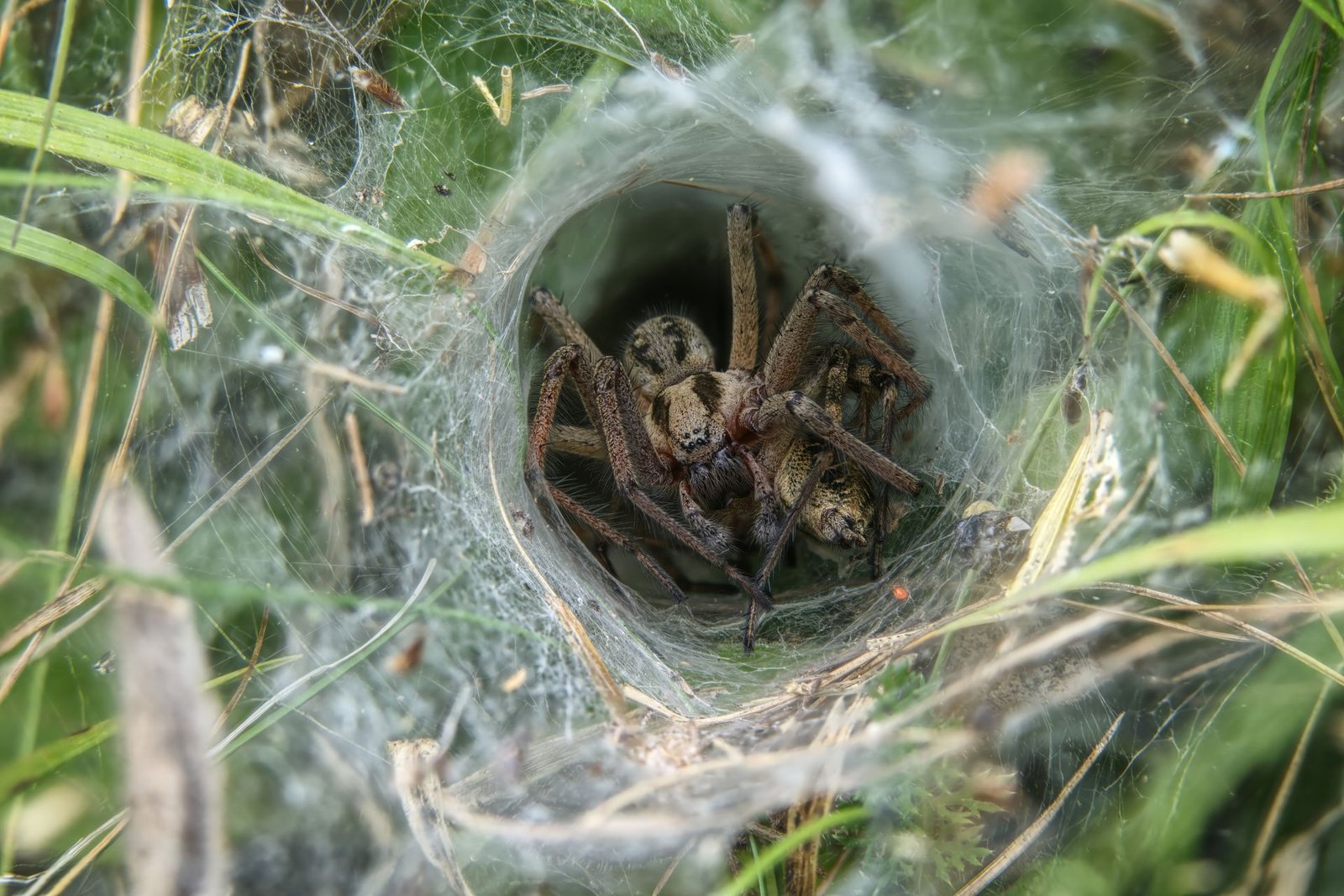
The air in Sulfur Cave smells of rotten eggs. A warm stream runs along the floor, lined with white slime, and a cloud of tiny flies hangs above the water. About 50 meters (165 feet) in from the entrance, where daylight never reaches, one wall is wrapped in silk.
That silk is very likely the world’s largest spider web. It’s a single sheet of about 106 square meters (1,140 square feet), roughly the floor of a roomy family apartment, built by some 69,000 barn funnel weavers (Tegenaria domestica) and more than 42,000 tiny sheet weavers (Prinerigone vagans). Neither species had ever been seen living in colonies. And the whole spider city runs on food made without sunlight, by bacteria that feed on the sulfur in the water. A team led by István Urák, a biologist at Sapientia Hungarian University of Transylvania in Romania, described the colony on Oct. 17, 2025, in the journal Subterranean Biology.
Two familiar house guests built it. The barn funnel weaver is the brownish spider many people find in sheds, basements and closets. It normally lives alone, in a flat web that narrows into a tube where it waits. P. vagans is a much smaller spider, also common near homes. In the cave, thousands of separate funnels have fused into one patchwork, a bit like an apartment block where every unit shares its walls. Some sections grow so heavy that they peel off the rock under their own weight.
Where the world’s biggest spider web was found
A cave that straddles a border. Sulfur Cave sits in the Vromoner Canyon, carved by the Sarandaporo River. Vromoner means “smelly water” in Greek, and the name fits. The cave’s entrance is in Greece, while its deeper passages run under Albania. Springs inside feed a stream that stays at 26 degrees Celsius (79 degrees Fahrenheit) all year and carries hydrogen sulfide, the gas behind that rotten-egg smell. Cavers from the Czech Speleological Society first reported the giant web in 2022. Urák and his colleagues then went back on seven trips between 2023 and 2025 to study it.
Counting spiders, one funnel at a time. Nobody counted 111,000 spiders by hand. The team pressed a small square frame, 15 centimeters (about 6 inches) on a side, against the web at 30 random spots and took photos. They counted the funnels in each picture and scaled the average up to the whole wall. For the smaller species, they counted the spiders themselves. Counting spiders is a craft of its own, as a census of Joro spiders on Atlanta’s forest trails shows.
What cave spiders eat when there is no light
The menu starts with slime. Here’s the thing about most caves: they’re food deserts. With no sunlight, nothing green grows, so animals live on scraps that wash or fall in from outside. Sulfur Cave works differently. Bacteria such as Beggiatoa and Thiothrix coat the stream bed in white mats. They draw energy from the hydrogen sulfide in the water, a process called chemosynthesis, and use it to build living matter the way plants use light. The larvae of a non-biting midge, Tanytarsus albisutus, graze on those mats. The adult midges then swarm over the stream and straight into the silk.
The spiders’ bodies keep the receipts. To trace who eats whom, the team measured stable isotopes, slightly heavier and lighter forms of carbon and nitrogen atoms. Food leaves its isotope mark in whoever eats it, like a postmark on a letter. The midges and the spiders in the web carried a mark clearly different from that of spiders and other animals living outside. So their food chain begins with the cave’s sulfur bacteria, not with sunlight. The web also hangs right where the fly swarm is thickest. The researchers counted about 45,500 resting midges per square meter of wall. Scaled up, that’s roughly 2.4 million flies, or about 20 for every spider.
The little spider gets a free pass. A barn funnel weaver would normally be glad to eat something the size of P. vagans. In the cave, it doesn’t seem to bother. The authors suspect the darkness is why. The funnel weaver may rely on its eyes more than the dark allows, while P. vagans sits still in ambush and only moves when prey comes close. In pitch black, it may be close to invisible. That’s an idea the team put forward, not something it tested.
Why house spiders formed a colony underground
Plenty of food can turn loners into neighbors. Spider colonies aren’t new to science. In the tropics, some hold more than 100,000 spiders, and they tend to form where prey is unusually abundant. In Central Europe, the bridge spider Larinioides sclopetarius, one of the few colonial species there, gathers in groups of 60 to 200. But no colonial behavior had ever been recorded in the families of either Sulfur Cave species. And no cave spider anywhere had been confirmed as truly colonial. The closest case, a spider of the genus Goeldia in a Brazilian cave, showed only limited teamwork. The authors call the Sulfur Cave colony “facultative”: the species can live together when food allows it, but they don’t have to.
The cave spiders have drifted from their cousins. DNA told a second story. All 32 barn funnel weavers sequenced from the cave shared the same version of a mitochondrial gene. It sits one mutation away from the most common version, found in spiders from North America to New Zealand. The cave’s P. vagans sat three mutations away from its own common type. The authors read this as a sign that the cave population doesn’t mix with spiders outside. Their gut bacteria point the same way. A single funnel weaver caught outside a nearby cave carried about 30 kinds of bacteria. The cave spiders had far fewer, with a diversity score of 0.82 against 2.99 for the outsider. Their egg sacs were smaller than those reported for surface spiders, too, and fullest in early summer.
What the Sulfur Cave study can’t say yet
Some numbers come with asterisks. The spider totals rest on 30 small photos scaled up to a wall treated as a rough rectangle. Empty funnels are hard to tell from occupied ones, so the authors expect the true count to be a little lower. The gut bacteria comparison used just one spider from outside, and the team calls those results quite preliminary. Honestly, the “world’s largest” label is a judgment, not a measured record. The paper itself calls the colony extraordinary, while Urák has described it to reporters as likely the biggest web on Earth. Isotopes also show what the spiders ate over time, but they can’t explain why two species that usually live apart began sharing one web.
The next job is keeping it. Sulfur Cave belongs to a rare family of caves that run on chemosynthesis. The first one, Movile Cave in Romania, was found in 1986 and described in the journal Science in 1996. Others have since turned up in places including Italy, Israel, Greece, Iran and Albania’s Sarandaporo Valley. The Sulfur Cave work is part of a conservation effort for the cave ecosystems of the Aoos-Vjosa river basin, and a colony that sits across a border will need both countries to protect it. Meanwhile, the deeper, damper parts of the cave hold a second food web, built on bacteria growing on the walls, that the team has only started to describe.
The study at a glance
- Journal: Subterranean Biology, October 2025
- Type of study: Field survey with photo counts, DNA barcoding, stable isotope tests and gut bacteria analysis
- Sample: The spider colony on one wall of Sulfur Cave, on the Greece-Albania border, studied on visits from 2023 to 2025
- Main finding: A web of about 106 square meters holds roughly 69,000 barn funnel weavers and over 42,000 P. vagans, fed by a food chain that starts with sulfur bacteria.
- Limits: The counts are extrapolated and may run high, and the gut bacteria comparison used a single surface spider.
Source: Urák, I., Vrenozi, B., Głąbiak, Z., Lecoquierre, N., Eiberger, C., Maraun, M., Ştefan, A., Flot, J.-F., Brad, T., Dainelli, L., Sarbu, S. M., and Băncilă, R. I. “An extraordinary colonial spider community in Sulfur Cave (Albania/Greece) sustained by chemoautotrophy.” Subterranean Biology 53: 155-177 (2025). DOI: 10.3897/subtbiol.53.162344