 Editorial NexoScience
Hydrogen cyanide is a poison. It’s also one of the best starter kits chemistry has for life. In the lab, a strong solution of it can build sugars, fats and pieces of RNA and DNA. Comets are loaded with the stuff. So for more than a century, scientists have asked whether comets delivered the origin of life to Earth, crashing in with a ready-made chemistry set.
New computer simulations say that delivery almost never worked. During Earth’s early bombardment, more than 100,000 comets wider than a football field hit the planet. In more than half of the simulated histories, not one of them dropped enough intact cyanide on dry land to get that chemistry going. The study, led by planetary scientist Richard Anslow, who did the work at the University of Cambridge in England, was published in October in the journal Scientific Reports. The authors call a successful delivery “an exceedingly rare event.”
The comet idea has a long shelf life. In 1992, Christopher Chyba and Carl Sagan worked out that most of the carbon falling on the young Earth came as fine dust, not comets. But that dust carries mostly tough, tar-like carbon that early chemistry can’t use. Comets are different. They hold hydrogen cyanide at about one molecule for every thousand molecules of water. In theory, that’s enough to make a strong local brew where a comet lands. That’s why comets kept coming back into the story.
Why hydrogen cyanide matters for the origin of life
One molecule stands in for all the rest. Hydrogen cyanide, or HCN, is a carbon atom and a nitrogen atom held by a triple bond, with a hydrogen attached. That bond stores energy that can push later reactions along. Lab work shows that HCN at about 10 millimolar, a fairly strong solution, can make many of life’s building blocks. It’s also the only such starter molecule seen in comets at levels that matter. And the triple bond makes it tougher than most organic molecules. So the team’s logic was simple. If HCN can’t survive the trip, the fragile molecules have even less of a chance.
The team replayed Earth’s bombardment again and again. Older studies used the Moon’s craters as a record of what hit Earth. The researchers took a different route. They used a model that follows a million icy bodies born beyond Neptune and tracks which ones fall toward the sun. Small comets often spin themselves apart before they get close, which cuts the number that reach Earth roughly tenfold. Then the team ran 100,000 simulated histories of Earth’s early impacts. Each comet had to survive the fall through the air. Then it had to survive the crash. Then it had to land somewhere useful.
Can organic molecules survive a comet impact
The sky is the first filter. Comets are fluffy and weak, more like a packed snowball than a boulder. Any comet smaller than about 330 feet (100 meters) blew apart high in the air, whatever its angle, and scattered its cargo over a huge area. Comets that come in at a shallow, grazing angle have to plow through far more air, so many of those broke up too. The team used an atmosphere like today’s, about 1 bar of pressure at the ground. Early on, Earth’s air may have been far thicker, which would only make things worse.
Then comes the heat. Short-period comets, the kind that loop around the sun in under two centuries, hit Earth at about 63,000 mph (28.2 kilometers per second). That’s nearly 30 times faster than a rifle bullet. At those speeds, most of the cyanide is cooked into carbon monoxide and carbon dioxide, which do little for early chemistry. HCN only makes it through in a narrow sweet spot: a slow comet coming in at a shallow slant. You know what? That’s exactly the kind of comet the atmosphere tends to destroy. The two filters work against each other.
A splash in the sea ruins everything. Even a comet that kept its cyanide had to hit dry land. In the ocean, the HCN spreads out and breaks down before it can do anything. Trouble is, the early Earth had very little land, perhaps just a few volcanic islands, at the very time comets fell most often. Spread across a whole ocean, all the HCN comets delivered adds up to about 0.75 micromolar. That’s more than ten thousand times weaker than the 10 millimolar the lab recipes need.
The most likely number was zero. The median count of successful hits per simulated history was zero. And the authors stacked the deck in the comets’ favor. They chose thin air, a generous amount of dry land, and assumed the cyanide was diluted only by the comet’s own melted ice. When a lucky hit did happen, it most likely came about 4.41 billion years ago. That’s more than 100 million years before the first indirect signs of life, at around 4.2 billion years ago.
Why Mars was a softer target for comets
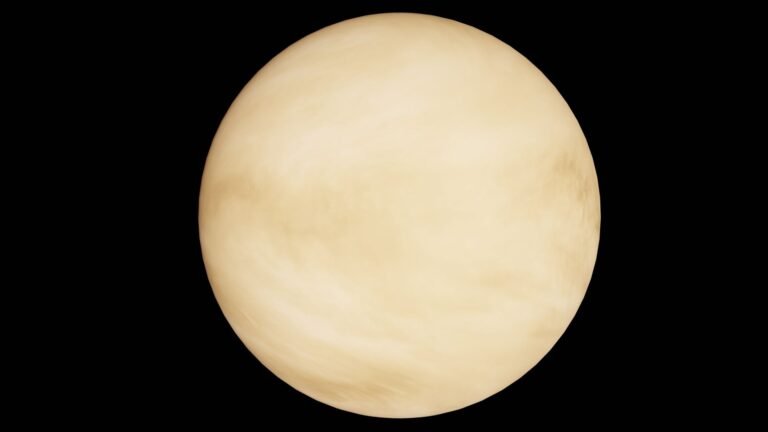
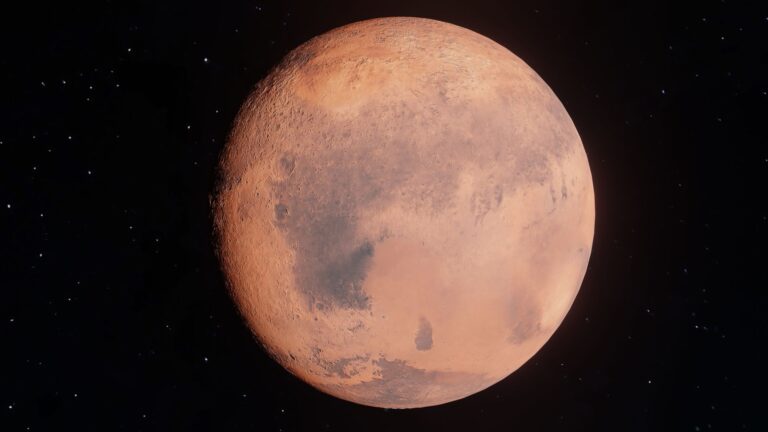
Mars got the gentler deal. The same model ran for our neighbors. Mars gets about five times fewer comets than Earth. Yet its thin air and weaker gravity mean comets arrive slower, at around 44,000 mph (19.7 kilometers per second), and nearly all the big ones reach the ground. Leaving aside whether there was land to hit, the simulations gave Mars 744 cyanide-rich impacts, against 87 for Earth and just 24 for Venus, whose thick air shreds comets more than a mile wide. Even with a denser early atmosphere on Mars, its count stayed more than five times Earth’s. If comets were a needed step, the authors wrote, that would raise the odds that life got a start on Mars.
Where the building blocks of life may have come from
The model has soft spots, and the authors name them. These are simulations, not measurements of real ancient impacts. Little is known about the air, land and oceans of the Hadean, Earth’s earliest eon, so the team picked the friendliest values it could. The authors acknowledged they can’t rule out one fortunate comet that came in slow and shallow and kept almost all its cyanide. And the Mars result ignores land and water. Once dry land is counted on Earth, its median falls from 87 to zero, and a warm, wet early Mars could see a similar drop.
A lucky strike still faces a ticking clock. Let me explain. Even if a comet left its cyanide in a fresh crater, groundwater and rain would flood that crater lake within days to weeks. The chemistry would have to finish before the brew went weak. The team built a rough toy model around that short window. It rests on an abiogenesis rate, the odds that chemistry turns into life, that nobody really knows. Still, for plausible values, the time needed for life to start from comet deliveries alone came out longer than the age of the universe.
Home-grown chemistry looks like the better bet. HCN can also form in Earth’s own air and rain down on all exposed land. Even in poor conditions, that source beats what comets delivered worldwide by orders of magnitude, the authors wrote. Other candidates often raised are carbon-rich asteroids, volcanoes and hydrothermal vents. Space chemistry is still part of the picture: lab work suggests a sugar molecule can form in deep-space ice. But forming in space and arriving intact are two different problems. Looking farther out, comets may do even worse. Many known rocky exoplanets are bigger than Earth, and many Earth-like worlds circle small red dwarf stars, where comets strike faster. Whether carbon-rich asteroids fare any better on the way down is the next question worth running.
The study at a glance
- Journal: Scientific Reports, October 2026
- Type of study: Computer simulations of early comet impacts on Earth, Mars and Venus, from atmospheric entry to the crash
- Sample: 100,000 simulated histories of Earth’s early comet bombardment, plus matching runs for Mars and Venus
- Main finding: The median number of comets that delivered a useful dose of hydrogen cyanide to dry land on early Earth was zero
- Limits: Based on models with uncertain early conditions; it cannot rule out one lucky slow, shallow impact
The study “Cometary impacts an unlikely pathway towards the origins of life on Earth,” by Richard James Anslow, Catriona H. McDonald, Amy Bonsor, Paul Brandon Rimmer and Auriol S. P. Rae, was published in Scientific Reports in 2026. DOI: 10.1038/s41598-026-74214-y.