 Editorial NexoScience
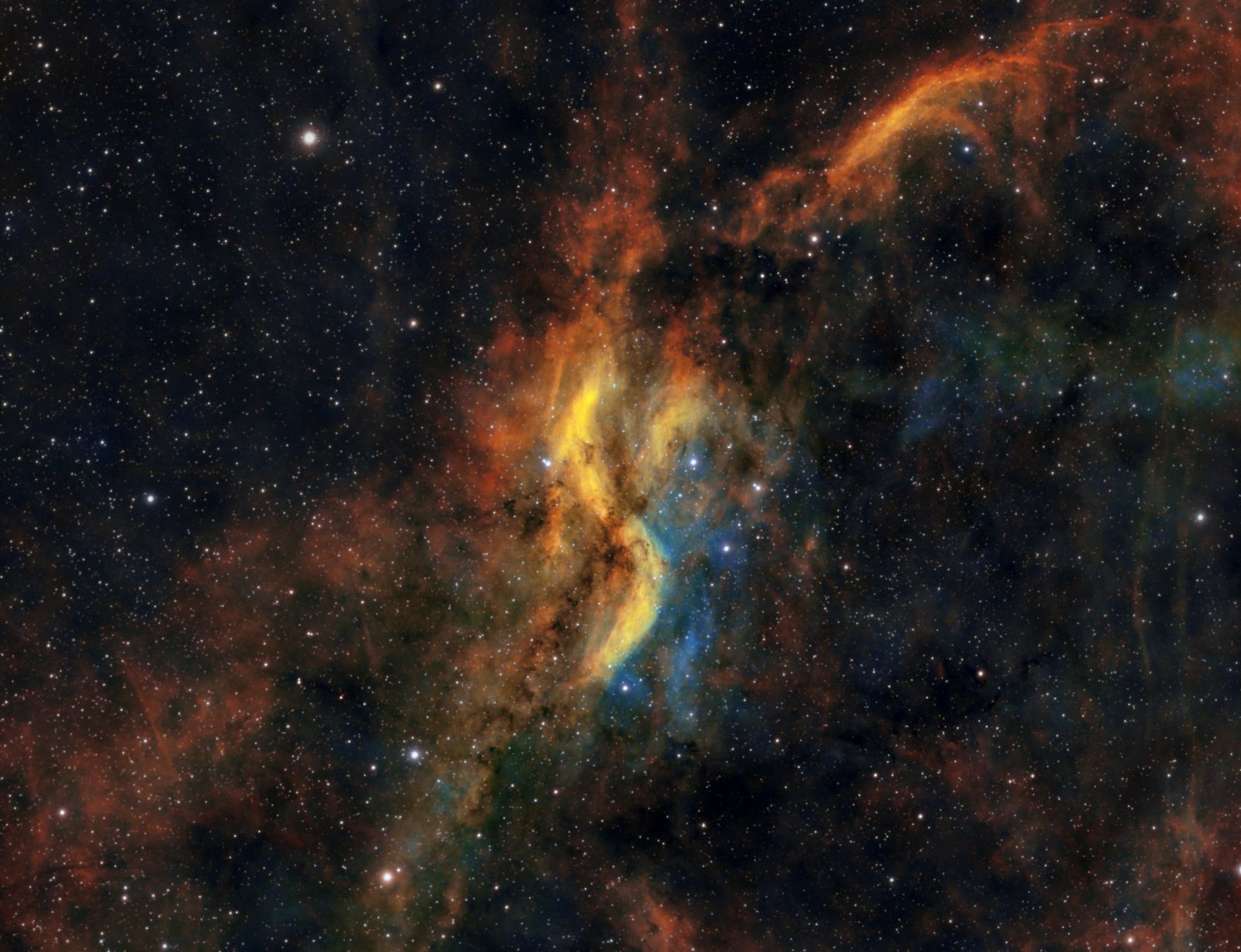
Start with a raspberry. Somewhere in its sweet flesh sits a small sugar called erythrulose. Now picture that same molecule drifting in a cold cloud of gas and dust close to the center of our galaxy, roughly 27,000 light-years away. That isn’t a thought experiment anymore.
For the first time, astronomers have spotted sugar in interstellar space. A team led by Izaskun Jiménez-Serra picked up the radio signature of erythrulose, a sugar built on four carbon atoms, in a molecular cloud called G+0.693-0.027 near the Milky Way’s core. The findings were reported in the journal Nature Astronomy. Until now, sugar had turned up in meteorites and on an asteroid, but never out in the space between the stars.
The surprise wasn’t only that it was there. Erythrulose came out at least eight times more common than the smaller, three-carbon sugars, which the telescopes didn’t detect at all. In most families of space molecules, each extra carbon atom makes a compound about ten times rarer. This sugar flipped that rule on its head.
There is sugar in space: what the radio survey found
Every molecule hums its own tune. As molecules tumble in space, they give off faint radio waves at very specific frequencies, a bit like a fingerprint written in static. The team pointed the 131-foot (40 meters) Yebes dish and the 98-foot (30 meters) IRAM dish, both in Spain, at G+0.693 in observing runs spread from 2021 to 2024. Together the two telescopes covered more than 91 gigahertz of the radio sky.
The cloud is one of the richest chemical pantries in the galaxy. It has already given up many new molecules linked to the chemistry of life. It also has a useful quirk: its gas is cold, so its spectrum is less crowded than the hot, packed cores around young stars. That makes faint signals easier to pull apart.
Finding one sugar among hundreds of other molecules is like picking out a single voice in a stadium. The researchers matched 12 sets of erythrulose lines, made up of 17 individual radio transitions, against a model that included more than 180 other species. Six of those sets were mostly clean, with no more than a quarter of their signal coming from anything else. The chance that six such lines would line up by accident is about 0.2%, the authors calculated. Honestly, that’s a strong case for a molecule nobody had seen in space before.
The search needed a lab trick first. To spot a molecule in space, you need its exact radio pattern from Earth. Sugars are fragile and soak up water, so heating them into a gas usually wrecks them. A recent method that vaporizes sugars with an ultrafast laser finally gave researchers clean data for erythrulose, ribose and a few others. Earlier hunts for small sugars in space had come back empty.
How sugar is made in space, on grains of ice
Two small pieces, one snap. If erythrulose had been built one carbon at a time, the three-carbon sugars should have been more common than it is. They weren’t. So the team looked at two smaller molecules with two carbons each, glycolaldehyde and ethylene glycol, which are both plentiful in the same cloud. Think of two short Lego pieces snapping together instead of a tower rising one brick at a time.
The chemistry happens on dust, not in empty space. Tiny grains of dust in the cloud are coated with ice, and molecules stick to that frozen surface. Using quantum chemistry, the researchers showed that hydrogen atoms can pluck hydrogen off both molecules, leaving two reactive fragments called radicals sitting side by side. Those fragments then join to make erythrulose. The slowest step is a flip in the electrons’ spin before the two halves can bond, yet the whole process still works at the cold temperatures of these clouds.
The same route makes both mirror versions of the sugar. Erythrulose is chiral, meaning it comes in left-handed and right-handed forms, like a pair of gloves. The ice reaction makes each form with equal odds. That matters because life on Earth uses only one hand of its sugars, and small imbalances of that kind have been measured in meteorites.
A computer cloud backed the idea. The team ran simulations that built up ice on dust grains over about a million and a half years, under strong cosmic-ray bombardment of the kind expected near the galactic center. Erythrulose came out as the most efficiently made four-carbon sugar in the model. Its predicted amount in the ice landed within a factor of five of what the telescopes measured in the gas, which is close by the standards of this field.
Why finding sugar in space is a significant discovery
The molecule sets several records at once. With 14 atoms, erythrulose is the largest molecule without a ring ever identified between the stars. It’s the first one found with four oxygen atoms, the first sugar, and only the second chiral molecule reported in interstellar space. More than 340 molecules have now been detected out there, and this one climbs a rung higher on the ladder of chemical complexity.
Sugar is a stubborn gap in origin-of-life chemistry. Life uses sugars for fuel and as the backbone of RNA and DNA. Yet lab experiments that try to make them under early-Earth conditions give poor yields, so researchers often just add sugars to their reaction mixtures by hand. Ribose and glucose have been found in old meteorites and in samples from the asteroid Bennu, which hinted that some of Earth’s sugar came from space. This detection pushes that story back further, to the cold clouds where stars and planets are born. For more on how rocks from space may have stocked the young Earth, see our roundup of recent space and astronomy discoveries.
Here’s the thing about erythrulose: in water, it doesn’t stay put. It readily rearranges into related sugars such as threose. Threose is the sugar inside threose nucleic acid, or TNA, a simpler cousin of RNA that some researchers think could have come before RNA in the earliest stages of life. Lab experiments have also built RNA building blocks from mixtures that include erythrulose.
The authors put a rough number on the delivery. Using the ratio of erythrulose to water in the cloud and estimates of how much organic matter rained onto the young Earth, they figured that somewhere between 500 million and 50 billion kilograms of the sugar could have arrived between 4.1 billion and 3.9 billion years ago. Small sugars are known to survive meteorite impacts, so at least some of it could have reached the surface intact.
What interstellar space is made of, and what’s still unknown
The detection is strong, but the story around it is still a model. Telescopes measured erythrulose in the gas. How it formed on ice grains comes from calculations and simulations, not from watching it happen. The researchers noted that their simulation overproduced the three-carbon sugars by roughly 25 to 70 times compared with what the cloud shows. They suggested several reasons, such as only part of the ice being blasted off the grains by shocks, sugars sticking back onto cold dust, or smaller sugars breaking apart faster in the gas.
Blending is a real headache in a cloud this crowded. Half of the 12 line sets overlap with other molecules or with unidentified signals. The authors relied on the six cleanest ones and on the overall match across the full set. The delivery estimate is also a back-of-the-envelope figure, and the intensity of the bombardment it leans on has itself been questioned.
Next, the hunt moves up the ladder. If a four-carbon sugar can form and survive in the harsh conditions near the galactic center, larger sugars and other molecules of life may be waiting in the same clouds. The open question is whether the raw ingredients for the first genetic molecules were cooked in space long before Earth existed.
The study at a glance
- Journal: Nature Astronomy, 2026
- Type of study: Radio telescope survey of a molecular cloud, plus quantum chemistry and computer simulations of ice on dust grains
- Sample: Radio spectra of the cloud G+0.693-0.027 near the Milky Way’s center, taken with the Yebes and IRAM telescopes in Spain
- Main finding: The four-carbon sugar erythrulose is present in interstellar space, at least eight times more abundant than three-carbon sugars, which were not detected.
- Limits: How the sugar formed comes from models, which overproduce the smaller sugars, and some of the radio lines overlap with other molecules.
Source: Jiménez-Serra, I., García de la Concepción, J., Cuppen, H. M., Rey-Montejo, M., Sanz-Novo, M., Rivilla, V. M. et al. “Detection of a four-carbon sugar in interstellar space.” Nature Astronomy (2026). DOI: 10.1038/s41550-026-02905-7