 Editorial NexoScience

There’s a frame in a telescope archive from Feb. 25, 2016, with a faint dot in it. The same dot turns up again in 2017, 2018, 2019 and 2023, drifting slowly across a crowded patch of Milky Way stars. Nobody flagged it. It took a new telescope and ten more years for anyone to notice that the dot was one of the brightest objects ever found beyond Neptune.
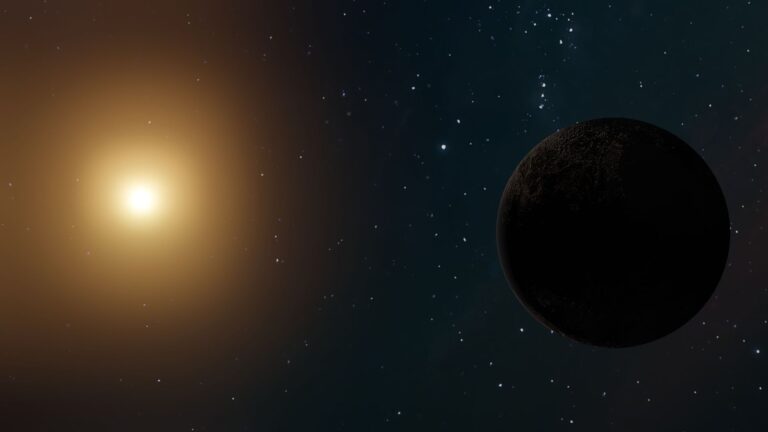
That object now has a name, 2026 ED138, and it’s a new dwarf planet candidate spotted in early data from the NSF-DOE Vera C. Rubin Observatory in Chile. It’s probably 380 to 950 miles (612 to 1,530 kilometers) wide, big enough that its own gravity has likely pulled it round. Only nine known objects past Neptune shine brighter in their own right, a list that includes Pluto, Eris, Makemake and Haumea. The work is described in a preprint posted Oct. 28 to the arXiv server and submitted to The Astronomical Journal.
The first hint came from software, not an eyepiece. Matthew Holman, an astrophysicist at the Center for Astrophysics | Harvard & Smithsonian and the study’s first author, wrote a linking code called pointdexter that sifts Rubin’s catalogs for faint dots that move from night to night. It first grouped 10 sightings of the object over 8 nights in May and June 2026. “My first reaction was one of excited disbelief,” Holman said in comments reported by ScienceAlert. “Objects like this are very rare, so I immediately started checking whether I or the code had done something wrong.”
A new dwarf planet discovered in old and new images
The team checked it was real, then went digging. No observation in the Minor Planet Center’s database matched it, and no known orbit passed nearby. Searching more Rubin images along its predicted path raised the count to 30 observations on 20 nights, from March 4 to July 11, 2026. That’s only 129 days, too short to pin an orbit down well.
So the researchers looked backward. Images from the Dark Energy Camera, on a telescope at Cerro Tololo in Chile, held the object on 14 nights between 2016 and 2023. Those old frames stretched the record to 3,789 days, more than ten years. With that, the orbit snapped into focus. 2026 ED138 circles the sun at an average distance of about 43 times Earth’s distance, on a path tilted about 24 degrees to the plane of the planets. According to the Minor Planet Center, one trip around takes roughly 281 years.
It keeps odd company. The orbit sits at the edge of a rhythm with Neptune called the 12:7 resonance, where the object goes around 7 times for every 12 Neptune orbits. Haumea, a known dwarf planet, lives in the same resonance. That raised an obvious question: is 2026 ED138 a chunk knocked off Haumea in an ancient collision? Its color says no. Haumea’s family has surfaces of nearly pure water ice, with colors close to the sun’s. 2026 ED138 is clearly redder, so the authors conclude it’s an unrelated object.
What makes a dwarf planet, and why this one is only a candidate
Brightness is easy to measure. Size isn’t. Astronomers can tell how much sunlight the object sends back, but not whether it’s a small, shiny ball of ice or a large, dark one. Think of a white golf ball and a charcoal soccer ball. From far enough away, both could look equally bright. That’s why the size estimate runs from 612 to 1,530 km. The authors think the lower half of that range, 612 to 968 km (380 to 600 miles), is more likely, because the largest bodies out there tend to be the more reflective ones.
Even the small end clears the bar. A dwarf planet orbits the sun, is massive enough to be pulled into a round shape, and hasn’t cleared its neighborhood of other debris. Icy bodies are expected to become round at about 450 km (280 miles) across, so even the smallest estimate for 2026 ED138 sits above that line. Size is only the first test, though. A light curve, the way the object’s brightness flickers as it spins, or a direct measure of its shape is still needed before anyone can call it round.
It has probably lost its most fragile ices. Pluto, Eris and Makemake are coated in methane frost. At 2026 ED138’s size and temperature, about 44 to 46 degrees above absolute zero at its closest to the sun, a simple escape model says methane, nitrogen and carbon monoxide should have leaked away over the solar system’s lifetime. Only a very dark, and therefore larger, version of the object could hold on to some of them. Finding any of those ices would test the model itself.
Why earlier sky surveys missed it
It was hiding behind the Milky Way. At its brightness, 2026 ED138 is well within reach of the big sky searches of the past two decades, which are thought to have found almost every object this bright over most of the sky. But it sits far south, and from 2000 to 2023 it stayed within 10 degrees of the Galactic plane, the thick band of stars most surveys avoided. Northern surveys couldn’t see that far south. One deep southern survey missed it by about a degree, because the object lay just past the edge of its fields. The Dark Energy Survey, the largest earlier southern search for these objects, stayed about 19 degrees away from it the whole time.
Honestly, Rubin nearly missed it too. The search that found it skipped the region within 10 degrees of the plane, and 2026 ED138 lay only about 2 degrees outside that zone. And in 24 of the 38 Rubin visits whose images show the object, Rubin’s own catalogs had no entry for it. Software tuned for ordinary star fields had merged the light of crowded neighbors into blobs too big to split, then thrown the whole blob out. The team recovered those sightings by fitting the object directly at its predicted spots, a trick that only works once you already know the orbit.
How many dwarf planets are there still to find
The search kept score against itself. Let me explain the method, because it’s clever. Of 33 known objects in this brightness class, 10 fell where the Rubin search could have found them, and it recovered 8. It also turned up exactly one new one. If unknown objects were as easy to catch as known ones, that ratio suggests about 4 were waiting before the search, 2026 ED138 among them. About 3 remain, away from the Galactic plane.
That number is shaky, and it’s probably low. It rests on a single discovery, so the authors’ 90% range runs from 0.2 to 20 objects before the search. Undiscovered objects are also likely harder to find than known ones, because they’re the ones earlier surveys missed. The count leaves out the band near the Galactic plane, which no search has covered this deeply, and very distant objects on stretched orbits. An earlier analysis estimated about 35, give or take 15, large scattered objects of this kind, most too far away to have been seen.
Comets that fall toward the inner solar system carry material from these cold outer regions, which is why researchers keep asking whether comets could have seeded life on Earth. A fuller map of what’s out there helps with that question too.
The object is bright enough to study up close. The authors say telescopes on the ground, plus Hubble and the James Webb Space Telescope, can now take its spectrum and track its spin. A near-infrared spectrum would reveal which ices cover it. Because it lies toward the crowded center of the galaxy, it will often pass in front of stars, and timing those brief blackouts can measure its size and shape directly. Over the next years, Rubin’s survey will keep sweeping the southern sky, including the crowded band that hid this one for so long.
The study at a glance
- Journal: Preprint on arXiv, October 2026, submitted to The Astronomical Journal
- Type of study: Discovery and follow-up of a distant icy object using telescope survey images
- Sample: 74 positions of 2026 ED138 from Rubin Observatory and the Dark Energy Camera, spanning more than ten years
- Main finding: 2026 ED138 is a large object beyond Neptune, about 612 to 1,530 km wide, and a dwarf planet candidate.
- Limits: Its reflectivity is unknown, so its true size and round shape are not yet confirmed.
Source: Matthew J. Holman, Mario Jurić, Kevin J. Napier, Jacob A. Kurlander, Aren Heinze, Joachim Moeyens and colleagues, “2026 ED138: A Large Trans-Neptunian Object in Early Rubin Observatory Data, and How Many More May Remain,” preprint, arXiv (2026). arXiv: 2610.38693. DOI: 10.48550/arXiv.2610.38693