 Editorial NexoScience
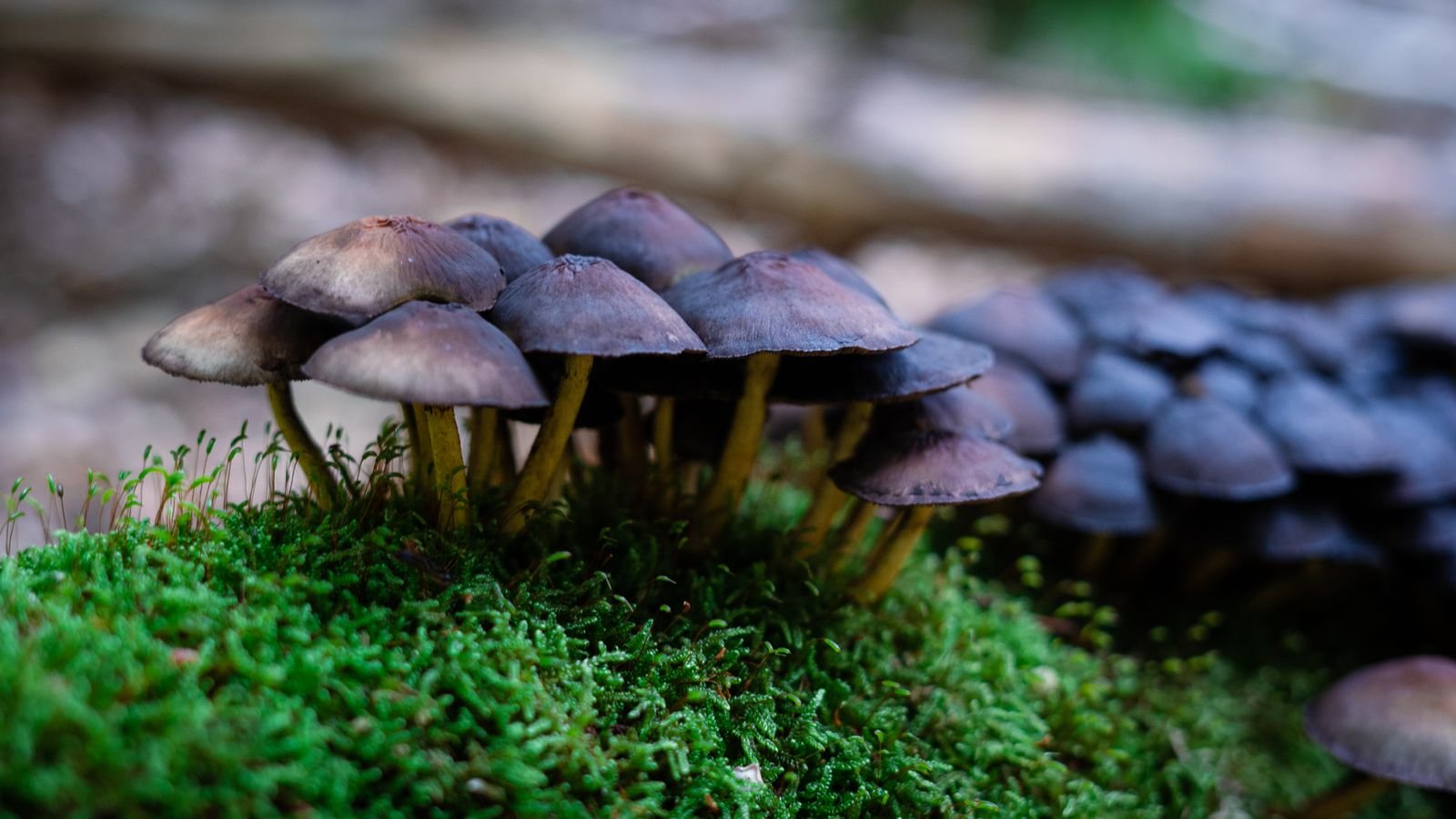
A rotting palm trunk in a Florida swamp, wrapped in wet moss. Small brown mushrooms poke out of it, the kind most hikers would step over without a second look. Mushroom hunters lump this whole crowd together as “little brown mushrooms,” and for good reason: they look alike, and some of them can kill you.
One of those mushrooms has now blurred the line people lean on when they think about magic mushrooms vs poisonous mushrooms. Galerina indica, which the researchers nicknamed the “dark magic mushroom,” makes both psilocybin, the psychedelic compound in magic mushrooms, and amatoxins, the poisons behind most deadly mushroom poisonings. No species had ever been shown to make both. The finding comes from a team at the University of Florida led by Andrew Kunik and Matthew Smith, and it was published in the journal Current Biology after a preprint version appeared on bioRxiv in July.
What makes poisonous mushrooms deadly
Amatoxins are a slow, quiet poison. They’re ring-shaped peptides, short chains of amino acids closed into a loop, and they show up in the world’s deadliest mushrooms, including the death cap (Amanita phalloides). Inside the body they jam RNA polymerase II, the enzyme every cell uses to read its own genes. Think of a factory where the machine that reads the blueprints suddenly seizes. Nothing new gets built, and organs start to fail. Amatoxins are responsible for most fatal mushroom poisonings, the authors note.
Psilocybin plays a different game entirely. Psilocybin and its partner psilocin, which the authors group together as “psiloids,” are the main active compounds in psychedelic mushrooms. They have a long history in Mesoamerican Indigenous traditions, and psychiatrists are now testing them as treatments, a field we follow in our guide to brain health evidence. The two chemical families do very different things to the body. They come from separate sets of genes, and until now they came from separate mushrooms.
The genus already had a deadly reputation. Galerina includes the Galerina marginata species complex, small mushrooms known as “funeral bells” that carry amatoxins. A 2021 study in PLoS One by B. Landry and colleagues mapped which Galerina species carry amatoxins, and before this new work the toxins had only been confirmed in the marginata group. No Galerina species with a known place on the family tree had been reported to make psilocybin.
How the dark magic mushroom was found
The team went looking for one poison and found a drug. Kunik and his colleagues were hunting for new amatoxin species in the southeastern United States, so they ran chemical tests on poorly studied Galerina. They gathered five specimens. Three came from moss-covered palm trunks in forested wetlands in Florida and turned out to be G. indica. A fourth grew on a dead pine in Mississippi, and a fifth on mossy soil in Florida. Neither of those two matched any named species.
The mass spectrometer told the story. This instrument sorts molecules by their mass, a bit like a coin counter that separates pennies from quarters. Every G. indica sample held psilocybin and psilocin alongside two amatoxins. The Mississippi mushroom made psilocybin but no amatoxins. The last one made neither. “We expected to detect amatoxins,” the researchers wrote in the study, “but were surprised to find psiloids.”
Even the poison was new. The main amatoxin in G. indica was a molecule nobody had described before, and the team named it alpha-proamanitin. It’s almost identical to alpha-amanitin, the most common of the deadly amatoxins, but it lacks one small chemical group, a hydroxyl, on one of its building blocks. Alpha-amanitin itself didn’t turn up in any sample.
How a mushroom picks up psilocybin genes from other fungi
Genes don’t always come from parents. Most traits in mushrooms pass from parent to offspring. Psilocybin and amatoxins are famous exceptions. Both have jumped between distant fungal species through horizontal gene transfer, a genetic swap that skips the family line. Picture a cook who never inherited a recipe from grandma but copied it off a neighbor’s fridge. A 2018 study in Evolution Letters by H. T. Reynolds and colleagues linked this kind of gene swapping to the spread of hallucinogenic mushrooms.
The recipe card came in a different order. The team sequenced the genomes of G. indica and of the Mississippi mushroom. Both held all five genes of the Psi cluster, the compact set of genes that builds psilocybin. But the genes sat in a different order and orientation in each one. Here’s the thing: separate gene orders point to separate arrivals. The simplest reading of the family tree is that psilocybin genes entered Galerina at least twice, once into a harmless lineage and once into a toxic one. The alternative, a single arrival followed by about a dozen losses, needs far more steps.
The poison got there first. The amatoxin genes in G. indica sit in a tight cluster arranged just like the one in other toxic Galerina, and their family tree matches the mushrooms’ own. That points to a single origin of amatoxins in the genus. So the order of events, as the authors reconstruct it, is poison first and psychedelic later. G. indica also carries a second, broken copy of a key amatoxin gene, with mutations that would stop it from working.
Why blue bruising can’t sort magic mushrooms from poisonous ones
The blue test has a blind spot. Psilocybin mushrooms often turn blue where they’re bruised, because psilocin links up into blue pigments. People use that blueing to tell psychedelic mushrooms from deadly ones growing nearby. The authors warn that the trick may only work for well-known species with a long history of human use, such as Psilocybe cubensis. In rare, poorly studied species, they write, the blue reaction “can accompany amatoxins,” as it does in G. indica. Honestly, that’s the line worth remembering. A blue bruise is not a safety certificate.
Two weapons may beat one. Nobody knows for sure why mushrooms make these compounds. The leading idea for both is defense against the animals that eat fungi, from snails and insects to nematodes, tiny soil worms that graze on fungal tissue. Amatoxins would strike after the meal. Psilocybin might work on behavior instead, putting grazers off or changing how they move. Carrying both looks like what milkweed plants do with mixed toxins, or what farmers do with crops engineered to carry more than one Bt toxin. An enemy that adapts to one weapon still faces the other. Lab studies show that nematodes and fruit flies can evolve resistance to amatoxins, so a second line of defense would be handy.
The study leaves big gaps, and the authors say so. The work rests on five specimens, only three of them G. indica, and it shows which chemicals and genes are present, not what they do in the wild. The defense idea is a hypothesis the team did not test. Potency is another open question. Alpha-proamanitin lacks the chemical group that helps amatoxins grip their target enzyme, and related amatoxins without it block that enzyme more weakly in lab tests. The authors stress that such amatoxins “remain toxic,” but they suggest the new one may be less potent than alpha-amanitin. Its effect on people has not been measured. Two rarely collected relatives, G. salicicola and G. minor, also need testing before anyone can say exactly when the psilocybin genes arrived.
The next clue may be waiting in the swamp. The authors suggest that gaining psilocybin may have eased the pressure to keep the poison at full strength, or that a weaker poison made the borrowed genes worth keeping. Either way, the dark magic mushroom packs the chemistry of the best-known psychedelic mushrooms and the deadliest poisonous ones into one small body, a natural test case for how borrowed genes shape a species. It was found during an undergraduate research project, in a group of mushrooms few people bother to study. That alone hints at how much is still out there.
The study at a glance
- Journal: Current Biology, 2026 (first posted as a preprint on bioRxiv in July 2026)
- Type of study: Chemical analysis and genome sequencing of wild mushrooms
- Sample: Five Galerina specimens from Florida and Mississippi, three of them Galerina indica
- Main finding: Galerina indica makes both psilocybin and amatoxins, the first species shown to produce the two together.
- Limits: Small sample; the defensive role and the potency of its new amatoxin were not tested.
Source: Kunik, A. R., Christopher, M. W., Lemmond, B., Dentinger, B. T. M., Slot, J., Garrett, T. J., Smith, M. E. “The ‘dark magic mushroom’ co-produces amatoxins and psilocybin.” Current Biology (2026). DOI: 10.1016/j.cub.2026.10.041
This article summarizes published scientific research for general information. It is not medical advice and does not replace consultation with a qualified health professional.