 Editorial NexoScience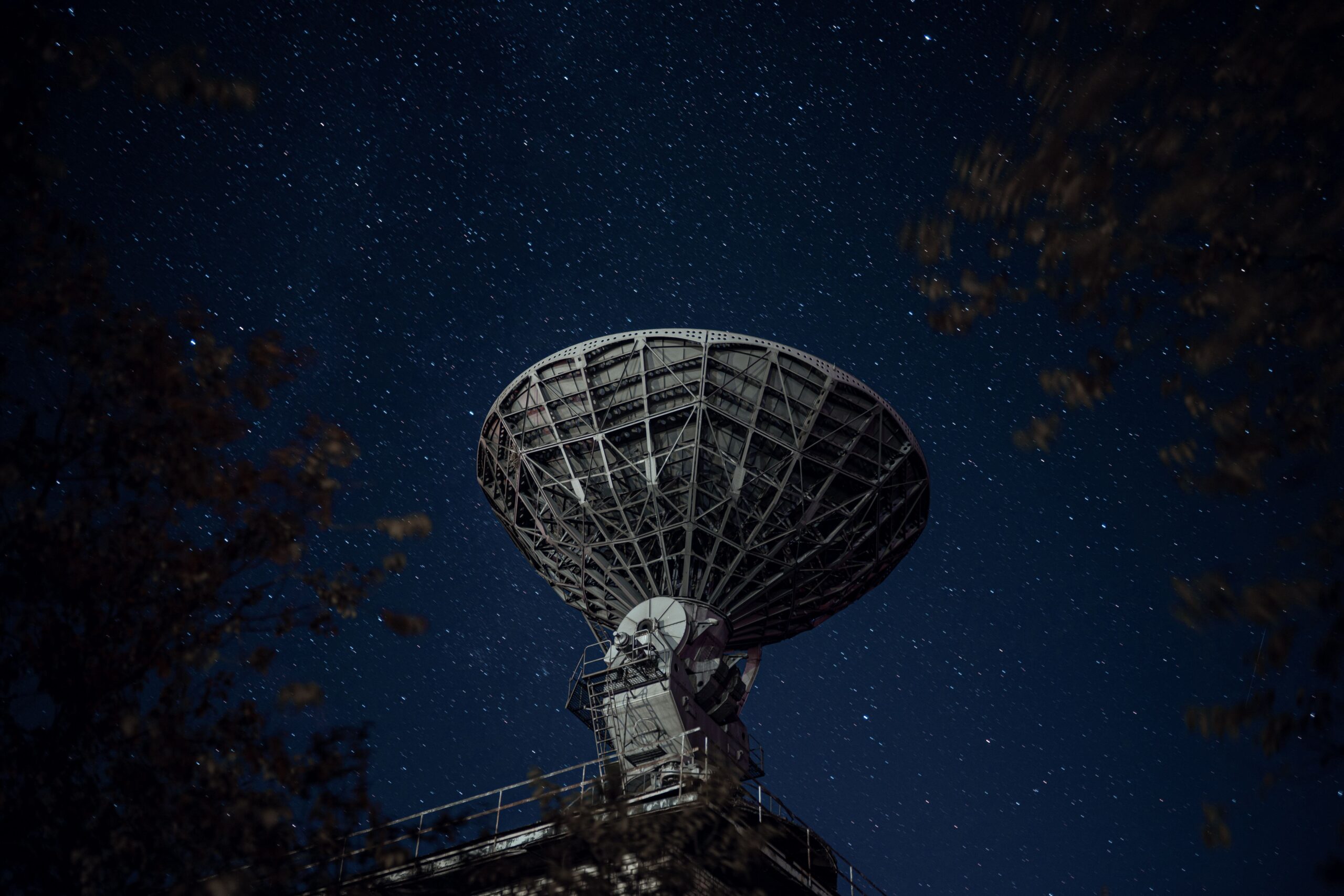
When physicists first argued in the late 1950s that we should point radio dishes at other stars and listen, they also picked the channel. Hydrogen, the most abundant element in the universe, emits at 1.4 gigahertz, and the reasoning was that any civilization hoping to be found would broadcast near the one landmark that anyone with a radio telescope would already know. Almost all the listening since has happened in that same narrow neighborhood.
A team working with the Sardinia Radio Telescope in Italy has now spent 73 hours listening somewhere else entirely, at 6 gigahertz and at 18 gigahertz, well above the hydrogen line. They found no convincing sign of an artificial signal anywhere in the data, the researchers reported in a study published online April 12 in the journal Acta Astronautica. The 18 gigahertz half of the survey is the highest frequency search of its kind carried out so far.
The telescope pointed at two very different kinds of target. One was a list of 72 stars flagged by NASA’s Transiting Exoplanet Survey Satellite (TESS) as hosting candidate planets that pass in front of them as seen from Earth. Planets in that geometry are promising because our own planetary radars leak powerful signals along the plane of the solar system, so a transmitter on a transiting world would be aimed roughly our way for the same reason. The other target was the Galactic Center, a patch of sky less than a third as wide as the full moon that still holds roughly half a million stars, and a plausible place for anyone wanting to signal the whole galaxy at once to park a transmitter.
A technosignature is a signal that nature is not known to produce. The team hunted specifically for narrowband drifting signals, transmissions squeezed into about a single hertz of the spectrum, which no known astrophysical process makes, and which slide slowly in frequency as the transmitting planet moves relative to us. Each star was observed in alternating on target and off target scans, so that anything appearing in both could be thrown out as terrestrial interference.
Nearly everything the dish picked up came from Earth. The search software flagged tens of thousands of candidate detections, and every one that survived the automated filters fell apart under visual inspection, appearing in the off scans, failing to repeat, or matching the profile of satellite downlinks and television broadcasts known to crowd the lower band. The higher band was a different environment. It produced about a tenth as many raw detections, and comparisons with earlier surveys near the hydrogen line show roughly an order of magnitude fewer false alarms once you climb above a few gigahertz.
An empty sky is still a measurement. Because the survey covered so many stars without a single detection, the team could set limits rather than simply report a blank. Fewer than one star in a thousand, they calculate, hosts a steady narrowband transmitter as powerful as one a civilization commanding all the energy available on its own planet could build. A civilization able to capture the full output of its star would have been trivially detectable at these distances, and nothing like that turned up either.
The absence of a detection is not the absence of transmitters, and the authors said so. Their pipeline demands that a candidate persist through a half hour observation, which means brief bursts, pulsed beacons, or anything switching on and off quickly would be smoothed away before it could be counted. Each session also captured only a slice of the available bandwidth at a time. Nothing here rules out signals that are weaker, briefer, or simply somewhere else on the dial.
The team plans to keep working through the rest of its queued TESS targets, and to bring machine learning into the analysis to catch faint or fast drifting signals that conventional software lets slip. The telescope itself is built to observe at frequencies far higher than the ones used here, which leaves a large stretch of the radio window still untouched.
Source: “The first high frequency technosignature search survey with the Sardinia Radio Telescope”, by Lorenzo Manunza and colleagues at the University of Cagliari, INAF and the Breakthrough Listen program, published in Acta Astronautica on April 12, 2025. DOI: 10.1016/j.actaastro.2025.04.007