 Editorial NexoScience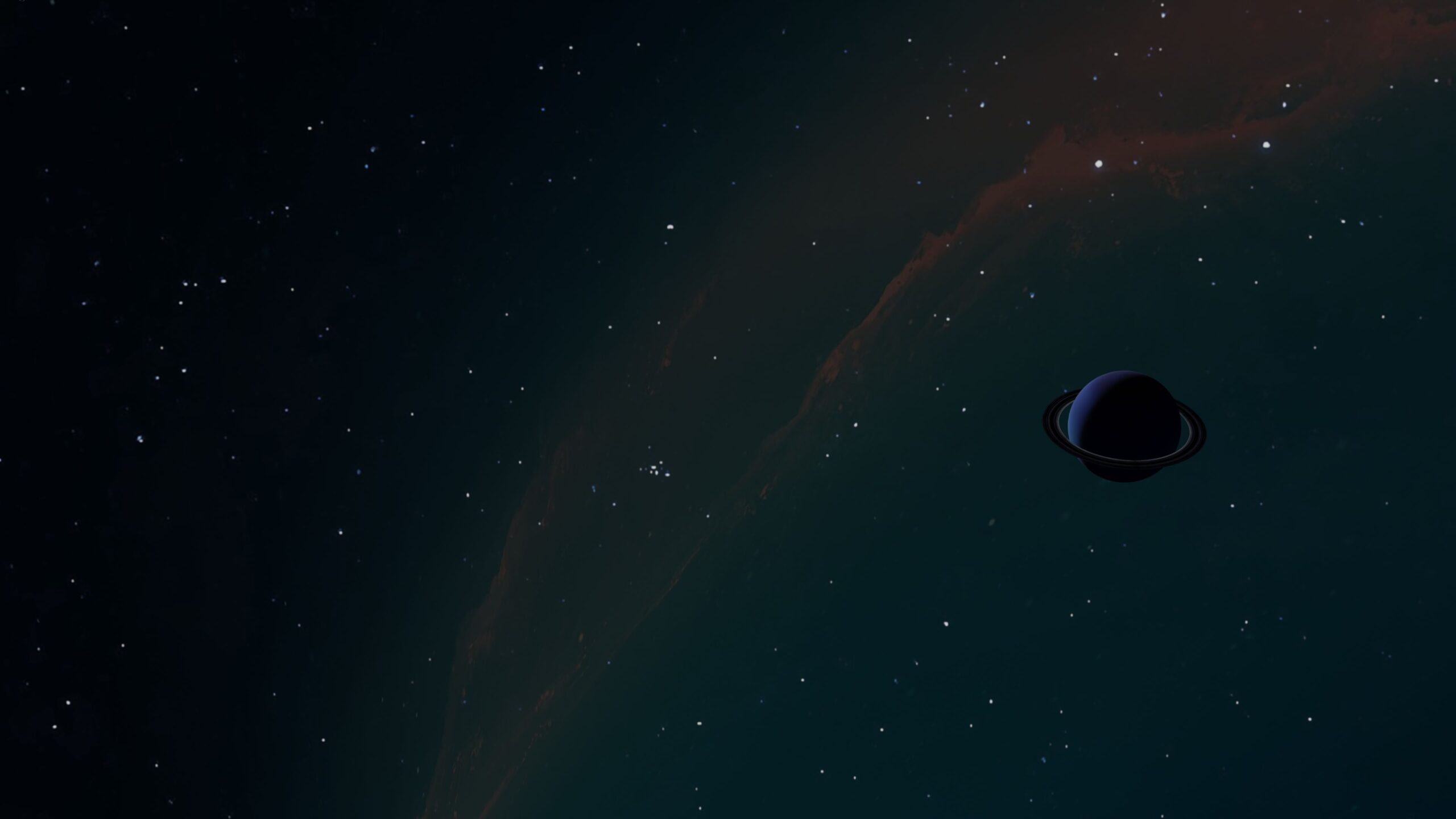
How do you weigh a planet that has no star, no orbit and no light of its own? For years, the honest answer was that you couldn’t. Astronomers have known for a decade that starless worlds drift through the Milky Way, because every so often one of them slides in front of a distant star and bends its light for a few hours. But the trick that reveals these wanderers has always refused to say how heavy they are. For one of them, that has now changed, and it turns out to weigh slightly less than Saturn.
This is the first free-floating planet whose mass has been measured directly rather than inferred. A team led by Subo Dong, an astronomer at Peking University in Beijing, reported the result Jan. 1 in the journal Science. The object, catalogued as KMT-2024-BLG-0792 by one survey and OGLE-2024-BLG-0516 by another, came out at 0.219 Jupiter masses, just under Saturn’s 0.30. Every earlier candidate had a mass that could only be estimated across the population as a whole, never pinned down for a single object.
The problem was never finding these planets, it was pinning them down. The technique is gravitational microlensing, the brief brightening of a background star’s light as an unseen mass drifts across the line of sight. Ground-based surveys spotted this one first, on 3 May 2024: KMTNet, which runs telescopes in Chile, South Africa and Australia, and OGLE, in Chile. The brightening lasted less than a day, and duration in microlensing scales with the square root of the lens mass, so a short event means a small object. What it doesn’t give you is the mass on its own. A light lens close by and a heavier one further away produce almost the same signal, a tangle astronomers call the mass-distance degeneracy.
A spacecraft parked beyond Earth’s night side supplied the second eye that broke the tie. Hold up a finger, blink one eye and then the other, and the finger jumps against the background. Microlens parallax works the same way. Two observers separated by a wide enough gap see the same brightening peak at slightly different moments, and the size of that offset carries the lens mass and distance. Europe’s Gaia spacecraft, which orbits the L2 point roughly a million miles (1.5 million kilometers) out from Earth, happened to sweep across this exact patch of sky, catching the event six times in sixteen hours. Its light curve peaked about 1.9 hours later than the one seen from the ground. That gap of under two hours is the entire measurement.
The planet turned up in a stretch of sky statistics that was supposed to be almost empty. Microlensing events can be sorted by the apparent size of the Einstein ring, the halo the source star’s light forms when it lines up behind the lens. Sorted that way, the known objects fall into two clumps with a conspicuous hole between them, nicknamed the Einstein desert. All nine free-floating planets found before this one sat below the desert; brown dwarfs and stars sat above it. This one landed inside it, in the empty stretch, which is exactly why its mass was worth chasing.
Its weight points to a planet that was thrown out, not to a star that failed to ignite. There are two ways to end up with a planet-size object adrift. It can collapse straight out of a cloud of gas, the way stars and brown dwarfs do, or it can grow inside a protoplanetary disk around a young star and then get flung out by gravitational shoving from its siblings. The lightest thing gas-cloud collapse is thought capable of making is heavier than Jupiter, and deep surveys of star-forming regions find that population cutting off several times heavier still. A Saturn-mass object sits comfortably below that floor. The team concludes it was born as a planet and evicted, which would mean violent dynamics shape the census of planet-mass objects both inside solar systems and outside them.
The authors are careful about what one event can and cannot settle. The mass carries lopsided error bars, and the true value could be about a fifth lower or a third higher, though it stays well under Jupiter in every case. Microlensing also sees a lens once and never again, so the data cannot separate a genuinely unbound object from one circling a host on an orbit so wide that the star leaves no trace in the light curve. The researchers describe it as either gravitationally unbound or on a very wide orbit, and leave it there. The origin story is the softest part: nobody watched this planet get ejected. It rests on comparing this event with the statistics of the others and with population simulations, which predict roughly two desert events among the ten now known. Finding one is consistent with that expectation, not confirmation of it.
The next measurement of this kind will need better luck or a spacecraft that can be aimed. Gaia was running a fixed survey and could not be redirected, and it normally revisits a given target about once a month, far too slow to trace an event that comes and goes inside a day. This one worked only because the star sat nearly perpendicular to the direction Gaia’s spin axis was drifting, a rare geometry that swung the field back into view again and again. At the light end of the range, down in the territory of rocky worlds, the observational constraints remain weak, the researchers wrote. The smallest wanderers are still out there, still unweighed.
The study, “A free-floating-planet microlensing event caused by a Saturn-mass object,” by Subo Dong, Zexuan Wu, Yoon-Hyun Ryu, Andrzej Udalski, Przemek Mróz and colleagues, was published in the journal Science (DOI: 10.1126/science.adv9266).