 Editorial NexoScience
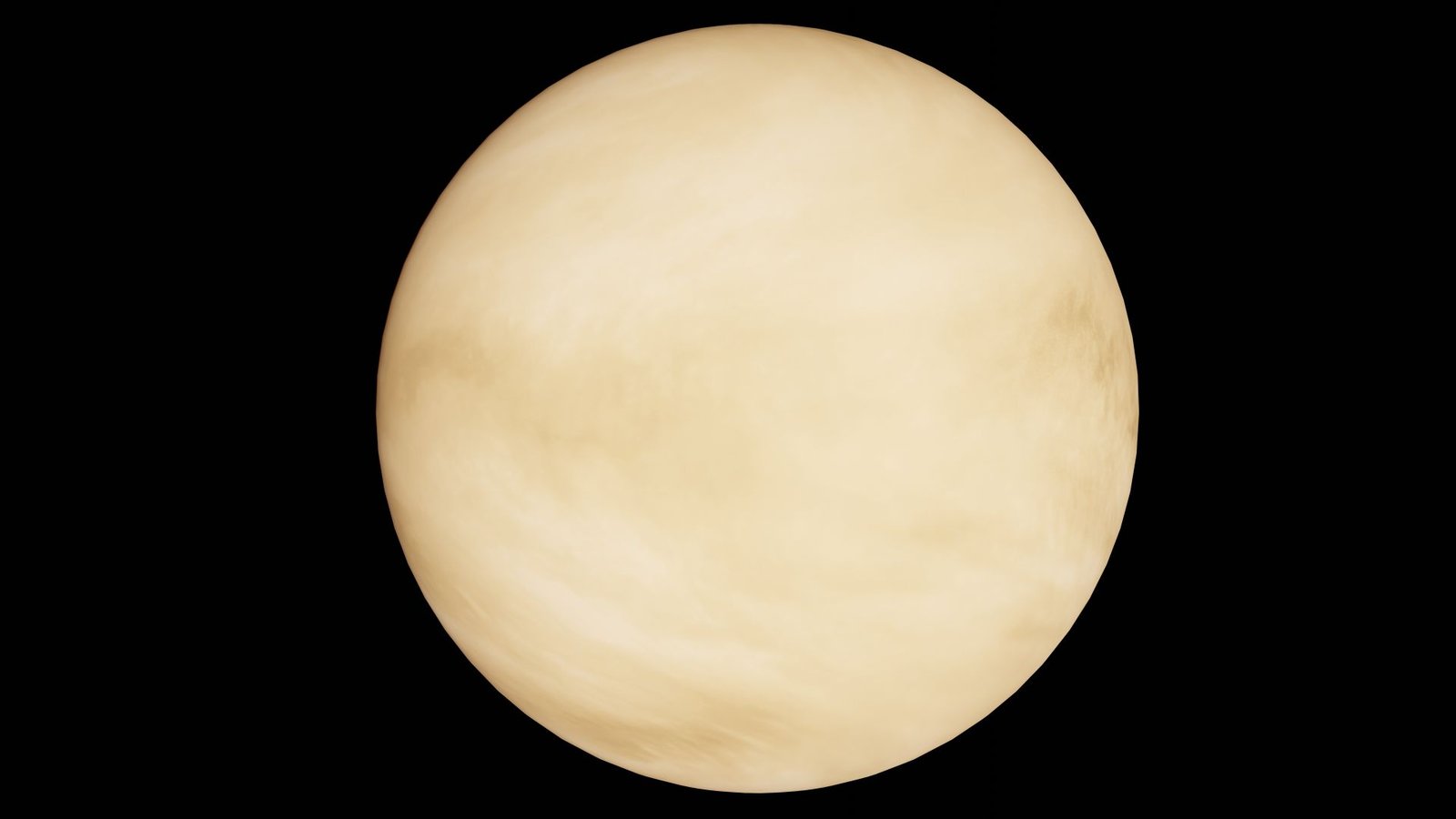
If you’ve ever spotted Venus blazing low in the sky after sunset, you’ve seen the brightest planet we have, and a lonely one. Earth and Venus are near twins in size and mass. Earth got a big moon. Venus got nothing, and its day is longer than its year: one turn takes 243 Earth days, and it spins backward.
Why Venus has no moon has puzzled planetary scientists for a long time. A new computer study suggests the answer may be hiding in that slow spin. If Venus ever had a moon, the tides between the two would probably have dragged it down until the planet swallowed it, with no outside catastrophe needed. The work, by planetary scientist Stephen Kane of the University of California, Riverside, and colleagues at the University of Bordeaux in France, was published Sept. 14 in The Astrophysical Journal. It doesn’t prove Venus ever had a moon. It shows how short that moon’s life would likely have been.
What happened to a Venus moon, according to tides
Tides work like a tug-of-war over spin. Our Moon raises a bulge on Earth, and because Earth spins faster than the Moon orbits, that bulge runs slightly ahead and keeps tugging the Moon forward. The Moon gains energy and drifts away, about 1.5 inches (3.8 centimeters) a year, while Earth’s day slowly gets longer. The key boundary is the “synchronous radius,” the distance where a moon’s orbit takes exactly as long as one turn of its planet. Satellites parked there hover over the same spot, like a TV satellite above Earth. A moon outside that line gets pushed outward. A moon inside it gets pulled in.
Venus moves that line the wrong way. As a moon steals spin from Venus, the planet slows, and the synchronous radius slides outward. If it catches the moon, the tug flips direction and the moon starts spiraling in. Today, with Venus turning once every 243 days, that line sits about 254 Venus radii out. That’s farther than the edge of the zone where Venus can even hold onto a moon against the Sun’s pull, at roughly 167 Venus radii. In other words, no stable orbit exists. Any moon Venus kept today would fall.
Falling ends at the Roche limit. That’s the distance, here less than three Venus radii, where the planet’s gravity pulls harder on the near side of a moon than its own gravity can hold together. A moon that crosses it gets torn into a ring of rubble that rains down on the surface.
How the model tested every kind of moon
The team ran Venus through a long list of what-ifs. They coupled the moon’s orbit to Venus’s spin and added the Sun’s tides too. They tried starting spins from 5 hours to 100 hours, moons from about the mass of the dwarf planet Ceres up to 10 times our Moon, and two different textbook ways of describing how rock flexes under tides. To check the machinery, they ran it on Earth and the Moon first. It reproduced the Moon’s present drift to within 3%: 3.69 centimeters a year, against the 3.82 measured by bouncing lasers off the lunar surface.
The moon mostly loses. If Venus started out spinning slower than about once every 16 hours, a moon at the starting distance began inside the danger line and hit the Roche limit within about a million years, whatever its size. For faster spins, the outcome hinged on mass. A moon’s outward push grows in step with its mass, but the speed at which it slows Venus grows with the square of its mass. So a heavier moon brakes the planet disproportionately hard, the line catches up, and the moon is doomed. In one of the two tidal models, a moon twice the mass of ours died somewhere between about 33 million and 1.7 billion years after forming. The moon’s tidal pull on Venus was about 3 million times stronger than the Sun’s, so the moon was effectively digging its own grave.
Kane said the results surprised him. “When I made this discovery, I was shocked,” he said in a statement from the University of California, Riverside. “I thought surely the broad range of scenarios I was exploring would lead to a variety of results. But it all went pretty much in the same direction.”
Survival is possible, just in a narrow corner. A moon about the mass of ours could last 4.5 billion years if Venus began spinning once every 12 hours or faster, much like early Earth. But simulations of giant impacts on Venus, published in 2025, suggest that collisions matching the planet’s present spin tend to leave it turning more slowly than that. The team points to a thin window, starting spins of roughly 12 to 15 hours, as the most likely match for real Venus. In that window, a lunar-mass moon dies slowly, over billions of years.
Why Venus spins slowly and what a moon would change
Venus already had other suspects. Earlier ideas said a moon might have been knocked away by a second giant impact, or that Venus never had a moon-making collision at all. A 2024 study proposed a captured backward-orbiting moon, nicknamed Neith, that would have spiraled in by itself. Here’s the thing: Kane’s group argues none of those big extra events is required. Two conditions have to hold at once, losing the moon and slowing a fast-spinning young Venus, and the tides can deliver both.
A moon may have mattered for water. Was Venus ever habitable? Some models suggest it may once have had oceans. A large moon would have steadied the planet’s tilt and stirred big ocean tides. Its fall would have dumped a huge pulse of energy into the surface and air, which the authors say could tie into the loss of water and the slide into the runaway greenhouse that bakes Venus today. That link is a possibility the paper raises, not something it tests. We’ve seen tides reveal hidden histories before, as in our story on what Mars’s seasonal tides say about its interior.
The model has clear limits. It’s a set of calculations, not evidence that a moon existed. The two tidal descriptions disagree for heavy moons, and real rock probably behaves somewhere between them. The model leaves out the tides that sunlight raises in Venus’s thick atmosphere, which also slow the planet. The authors note that adding them would make survival even harder, so their numbers lean generous. After publication, the team also fixed a plotting error in one figure. The underlying math didn’t change, and the corrected figure showed even more lost moons.
The proof, if there is any, is in the air. Venus’s surface was repaved by lava a few hundred million years ago, so any crash site is long gone, and a moon’s fall must have happened earlier than that. NASA’s DAVINCI probe, which will sample the atmosphere on its way down, might pick up the chemical traces of moon rock delivered from above. The same physics also hints that rocky exoplanets orbiting close to their stars, in what astronomers call the Venus Zone, should usually be moonless.
The study at a glance
- Journal: The Astrophysical Journal, September 2026
- Type of study: Computer model of tides between Venus, a hypothetical moon and the Sun
- Sample: Simulated Venus-moon systems spanning starting spins, moon masses, orbits and two tidal models
- Main finding: In most plausible cases a Venus moon spirals in and is destroyed, so no extra catastrophe is needed to explain the missing moon.
- Limits: Does not show that Venus ever had a moon, and leaves out atmospheric tides.
Source: Kane, S. R., Selsis, F., Leconte, J., and Raymond, S. N. “Tidal Demise: The Evolution and Fate of a Hypothetical Venus Moon.” The Astrophysical Journal (2026). DOI: 10.3847/1538-4357/ae9d6c