 Editorial NexoScience
Squeeze a tennis ball straight from the freezer, then one that’s been sitting in the sun. The cold one fights back. The warm one gives. Mars gets squeezed like that every year, by the Sun, and it turns out the planet doesn’t give evenly.
So is Mars hot inside? Yes, and lopsidedly so. The rock deep below the southern highlands is about 360 to 720 degrees Fahrenheit (200 to 400 degrees Celsius) hotter than the rock below the northern plains, according to a study led by Alexander Berne, a Caltech alumnus, and published Aug. 26 in the journal Nature. The team never drilled or listened for quakes. They worked it out from 16 years of radio tracking of three orbiters, which revealed how the planet’s gravity wobbles with the seasons. The hot half sits right under the half of Mars that already looks different on the surface.
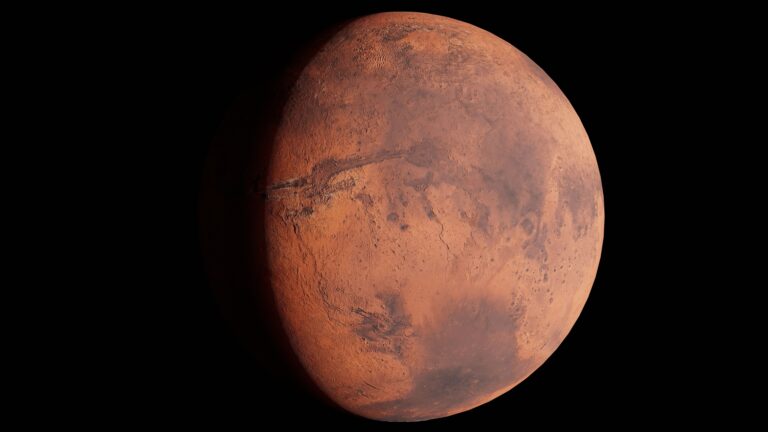
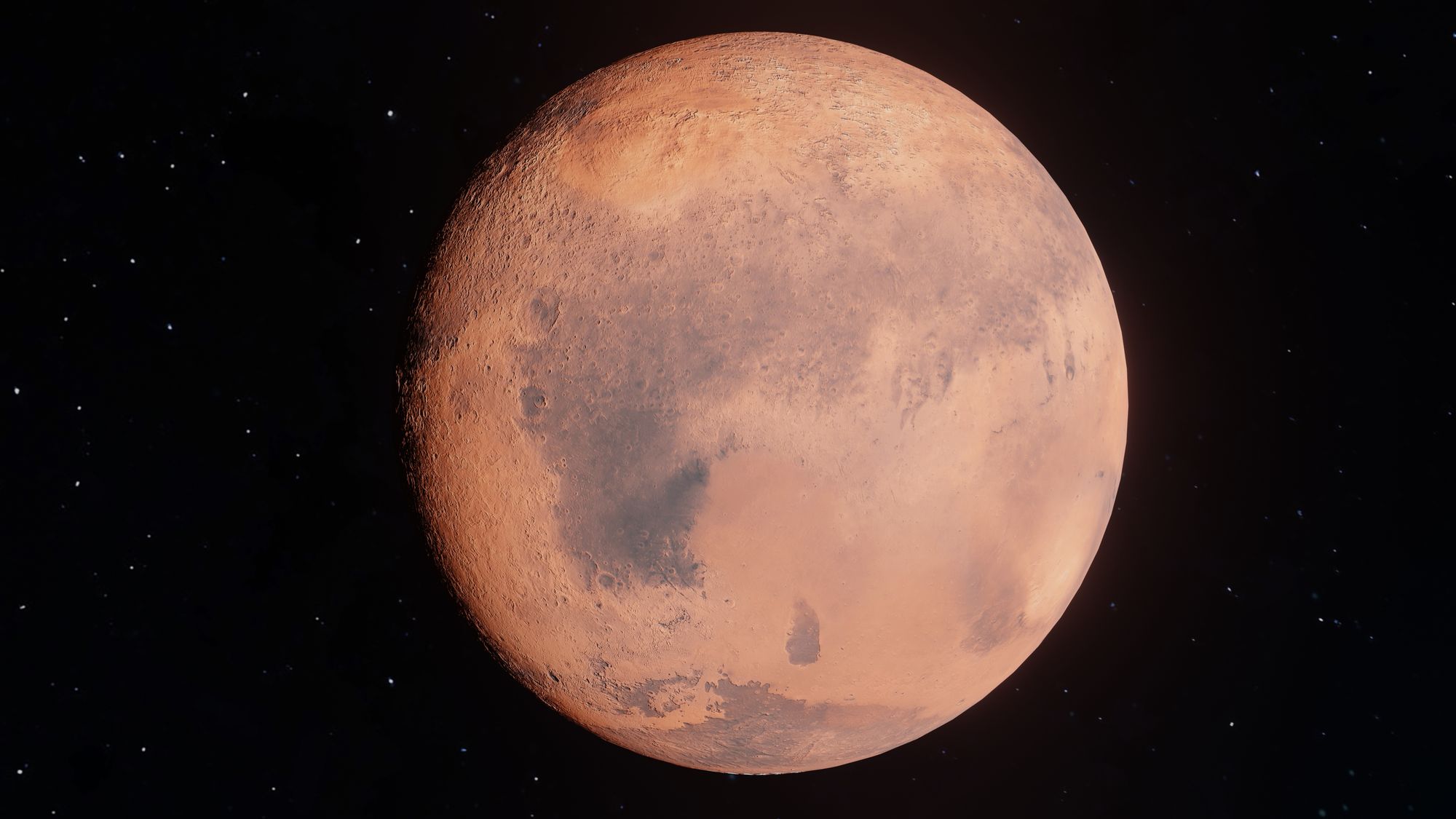
Mars has two faces. The northern hemisphere is mostly low, smooth plains. The southern hemisphere stands higher, rougher and packed with craters, and its crust is about 16 miles (25 kilometers) thicker on average. Planetary scientists call this split the crustal dichotomy, and they have argued about its origin for decades. One camp blames a giant impact. Another blames slow churning in the mantle, the thick layer of hot rock between the crust and the core. The question matters beyond geology, because the northern lowlands may once have held water.
How spacecraft tracking measured Mars’s seasonal tides
The Sun stretches Mars once a year. Mars follows an oval orbit and spins on a tilted axis, so the Sun’s pull on it rises and falls over each Martian year of 687 Earth days. The planet bulges a little in response, and that shifts its mass. Shifting mass nudges the gravity field, and gravity nudges any spacecraft in orbit. Using NASA’s Deep Space Network, the team measured tiny changes in the speed of Mars Global Surveyor, Mars Odyssey and Mars Reconnaissance Orbiter, then rebuilt the gravity field season by season. The method is called tidal tomography. It has been used on Earth and, more recently, on the Moon.
A signal that shouldn’t exist showed up. If Mars were the same all the way around, the yearly tide would barely touch a more complex part of the gravity field, the so-called degree-3 pattern. That part should read close to zero. Instead, some of its pieces came out up to 300% off the prediction, with better than 99.99% confidence for the strongest one. The team corrected for the Martian air too, because the atmosphere’s own seasonal swings also tug on gravity. The mismatch survived.
Stiffness was the missing piece. The best fit came from letting the stiffness of the mantle change from one side of the planet to the other. The overall difference came to more than 20%, and most likely far more. The stiff zone centers under the northern lowlands, over the plains of Vastitas Borealis. The soft zone centers under the southern highlands, near the giant Hellas basin. Even the line where the stiffness flips follows the surface border between highlands and lowlands. That match broke down only near Tharsis, the region of huge volcanoes, which may have smeared the old boundary.
Why Mars’s southern hemisphere runs hot underground
Heat softens rock, especially slowly. Over the few seconds of a seismic wave, rock’s stiffness hardly cares about temperature. To explain the observed contrast at that speed, the mantle would need a difference of more than 1,000 kelvin, which the authors call unrealistic. Squeezed over a whole Martian year, though, olivine, the green mineral that makes up much of the mantle, becomes about 15 to 20 times more sensitive to heat. That’s how the team arrives at a hot southern mantle of 200 to 400 degrees Celsius above the north. Think of cold honey versus warm honey: tap it quickly and both feel solid, but tilt the jar for a minute and the warm one runs.
Iron alone can’t do it. Could the difference be chemistry instead, more iron or water in the south? Mars’s center of mass would then sit far off its geometric center, about 50 times farther than measured, the team calculated. So composition plays a small part at most. The models allow up to 5% iron enrichment in the southern mantle, alongside the heat.
A hybrid history fits best. Each classic idea struggles alone. Slow upwelling or heat trapped by thick crust would melt rock and pull iron out of the southern mantle, the opposite of what the data hint. A giant impact on its own isn’t expected to keep one hemisphere hundreds of degrees warmer for billions of years. The authors sketch a combination. A huge impact forms the northern lowland crust and drains iron from the northern mantle. The thicker southern crust that’s left then works like a blanket, trapping heat or kicking off an upwelling below it. Let me explain why that’s appealing: it uses each idea for the part it handles well.
Marsquakes point the same way. NASA’s InSight lander, which listened to Mars from 2018 to 2022, recorded quakes from both halves of the planet. Waves from Terra Cimmeria, in the south, lost their energy faster than waves from Cerberus Fossae, in the north. Warmer rock damps vibrations more, so the two independent tools agree. The southern crust is also more strongly magnetized, and the authors suggest that heat from below may have shaped it while Mars still had a magnetic field, between about 4.5 billion and 4.1 billion years ago.
Molten rock, volcanoes and the missing southern eruptions
Hot doesn’t mean molten. The results don’t require any melt, the authors stress, and the quake damping in the south is still far weaker than partly molten rock would cause. Some thermal models do predict extra magma under a warm southern mantle, though. If so, it should have erupted within a few million years. Yet the only volcanism of the last few tens of millions of years sits at Cerberus Fossae, in the north. The team offers two ways out. The thick southern crust may trap rising magma halfway up, where it would cool into hidden intrusions. Or magma may need the crust to be stretching to escape, and the southern crust is mostly being squeezed.
The evidence still has soft spots. The stiffness map is an average over the whole mantle, from about 30 to 970 miles (50 to 1,560 km) deep, because the data can’t tell depths apart. Something concentrated near the top or the bottom would look the same. The error bars are wide, with the overall stiffness contrast at 81% give or take 60%, and the team inflated the formal uncertainties fifteenfold to stay cautious. The correction for the atmosphere depends on a climate model, and extreme dusty or very cold years weren’t tested directly. Turning stiffness into temperature also leans on lab models of how olivine behaves.
Next comes a sharper look. A dedicated gravity mission, like GRACE for Earth or GRAIL for the Moon, could map the same structure in far less time, the authors write, and electromagnetic soundings could check for pockets of melt. “Scientists usually assume that the interiors of planetary bodies are generally spherically symmetric, but this is not necessarily true,” Berne said in a statement. The same trick could work on Mercury, Io, Ganymede and Enceladus, with no lander needed. Mars has kept surprising orbiters and rovers alike, as when Perseverance found that Jezero crater’s ‘shoreline’ began as magma. This time, the clue was in a yearly squeeze.
Source: Berne, A., Wagner, N., Matsuyama, I., Goossens, S., Genova, A., Rovira-Navarro, M., et al. “Tidal tomography reveals a thermal anomaly beneath Mars’s crustal dichotomy.” Nature (2026). DOI: 10.1038/s41586-026-10893-x