 Editorial NexoScience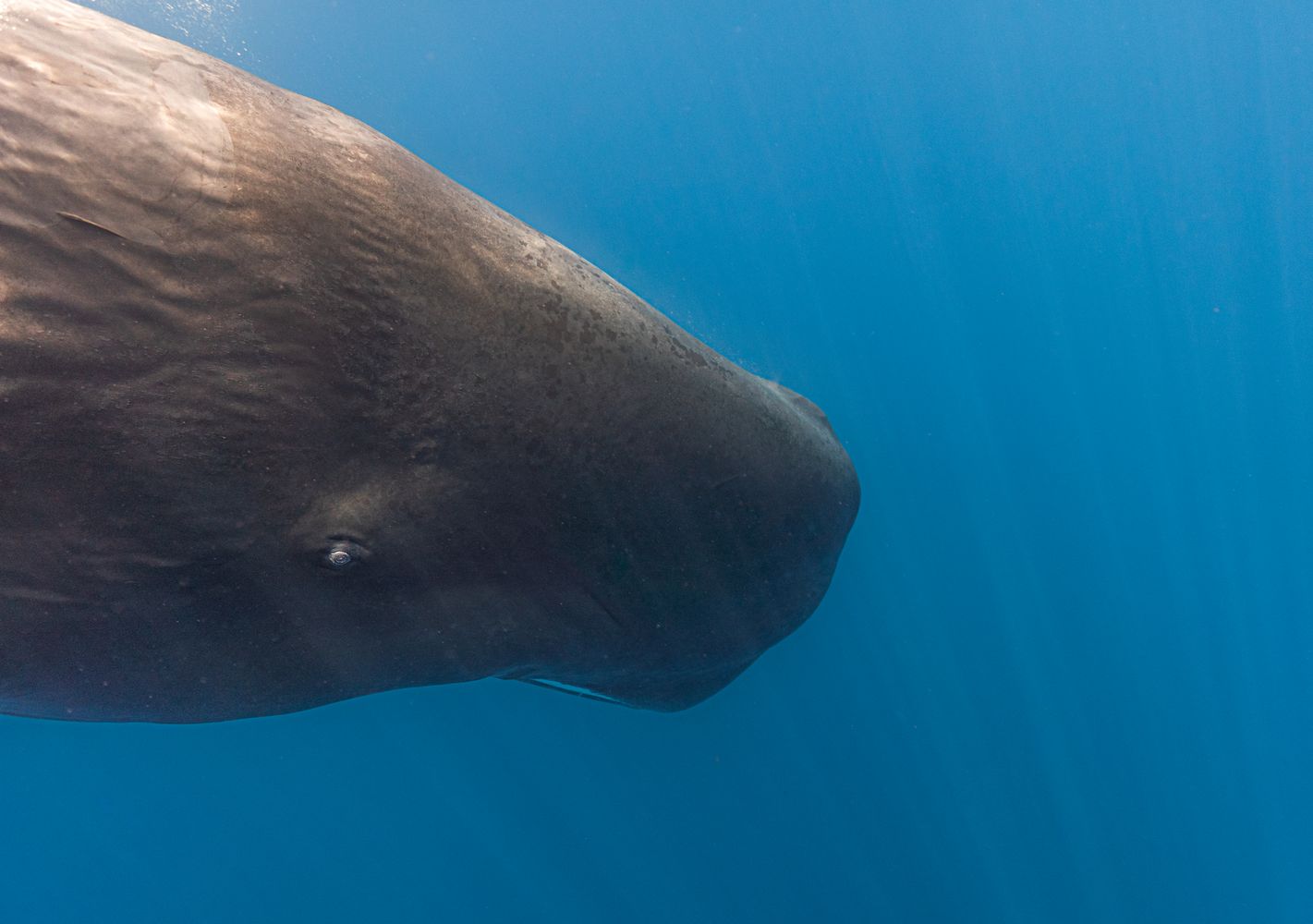
Two sperm whales click back and forth in the dark, four seconds apart, matching each other’s rhythm without missing a beat. That kind of exchange, recorded off the coast of Dominica, sits at the center of the most detailed structural analysis of sperm whale communication published to date.
Sperm whales talk almost entirely through codas, short bursts of three to forty clicks fired off in under two seconds. For decades, researchers sorted these codas into a fixed catalogue of about 21 types, based on the pattern of gaps between clicks, and treated that list as close to the whole vocabulary. A team from MIT, Project CETI and the Dominica Sperm Whale Project went back through 8,719 codas recorded between 2005 and 2018 from the Eastern Caribbean clan, a family group of roughly 400 individuals, and found the old catalogue was missing most of the structure.
The clicks are not fixed, they shift in real time depending on who else is talking. When two whales trade codas back and forth, each one gradually stretches or compresses the duration of its clicks from one call to the next, and its partner tracks that change. The researchers named this effect rubato, borrowing the musical term for deliberate tempo variation. The average duration gap between consecutive codas of the same type was 0.05 seconds, compared with 0.08 seconds expected if the variation were random. When two whales click at the same time, their durations line up even more tightly, 0.099 seconds apart on average against an expected 0.129 seconds.
A second layer, called ornamentation, adds an extra click that does not belong to the standard pattern. About 4% of recorded codas carried one of these extra clicks, and they showed up disproportionately at the start and end of a whale’s call sequence, and right before a change in how a group was chorusing together, a pause, a whale dropping out, another joining in. That timing suggests the extra click is doing something functional rather than sitting there as noise.
Underneath rubato and ornamentation, the codas themselves turned out to be built from smaller, reusable parts. The team found the clicks cluster into 18 distinct rhythm patterns and 5 duration classes, which combine freely with each other and with rubato and ornamentation, producing at least 143 distinguishable combinations in the recordings alone. By the authors’ estimate, that pushes the amount of information the system could carry to roughly twice what a 21-type catalogue would allow.
The researchers mapped all of it into what they call a Sperm Whale Phonetic Alphabet. The name is a deliberate echo of the International Phonetic Alphabet linguists use to chart the building blocks of human speech sounds, place of articulation, manner, voicing. Here the axes are rhythm, tempo, rubato and ornamentation, and the authors argue that whales combine them the same way human speakers combine phonetic features into an open-ended set of sounds, rather than simply picking from a short fixed list.
None of this proves the whales are exchanging anything like sentences or words with fixed meaning. The paper is explicit that it maps structure, not semantics: there are no playback experiments here confirming what any of these features actually communicate, and the authors flag that as the next, much harder, question. What the data does show is that a repertoire long assumed to be simple and repetitive is, mechanically, closer to how the sounds of human language get assembled than to a fixed signal code like a car alarm.
Study: Sharma P, Gero S, Payne R, Gruber DF, Rus D, Torralba A, Andreas J. “Contextual and combinatorial structure in sperm whale vocalisations.” Nature Communications, 2024;15:3617. DOI: 10.1038/s41467-024-47221-8.