 Editorial NexoScience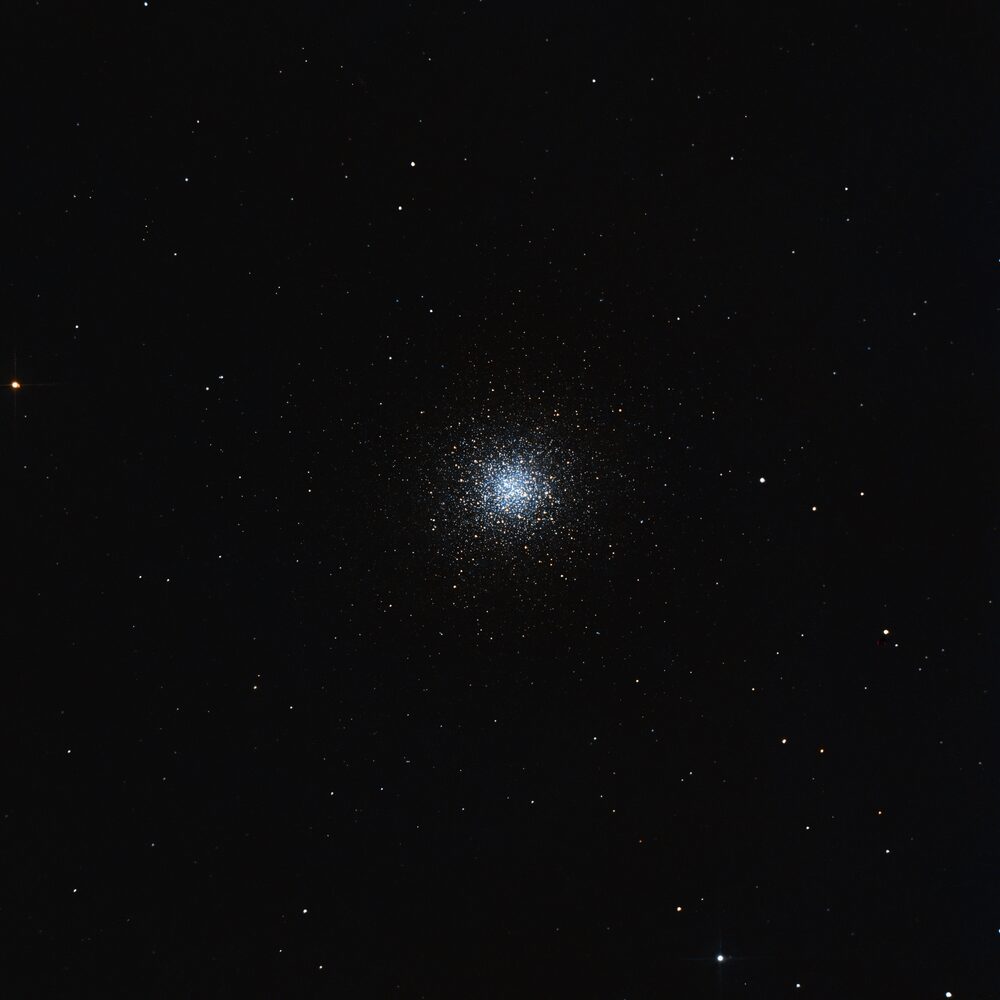
For twenty three years, one star buried inside a cluster of ten million others kept drifting off course, tugged by something nobody could see. Astronomers had been watching that cluster for exactly this reason, and they had almost given up hope of ever catching it happening.
The cluster is Omega Centauri, the largest and most massive globular cluster in the Milky Way, a tight ball of stars so dense that current models say it should be hiding around 10000 black holes inside its core. Despite deep radio surveys, X-ray searches and years of spectroscopy, not one of those black holes had ever been confirmed. Two similar objects had been found in a different cluster, NGC 3201, back in 2018 and 2019, and that was it.
The invisible companion finally gave itself away through pure physics. A team led by Matthew Whitaker at the University of Utah combined 351 exposures from the Hubble Space Telescope, spanning more than 20 years, with fresh James Webb Space Telescope images from 2024 and 2025. Together they tracked the exact position of a faint, ordinary star on the sky, one that sits right at the point where stars leave the main sequence. Its path was not a straight line. It curved, exactly as it would if the star were locked in orbit around something with real mass but zero light.
Running the data through years of orbital modeling, the team pinned down a companion with a mass of 4.46 solar masses, orbiting the visible star every 94 years on a wide, elongated path. That makes it the longest period black hole binary ever found, edging out every other confirmed system. The visible star itself weighs about 0.78 times the mass of the Sun, and the pair sits roughly 20 arcseconds from the cluster’s center, about half a light year away, at a total distance of nearly 17900 light years from Earth.
A neutron star could not explain what they saw. The heaviest neutron star ever precisely measured tops out at about 2.08 solar masses. At 4.46 solar masses, with a statistical range that only dips as low as 3.44 in the most conservative estimate, the object is comfortably inside black hole territory. X-ray and radio surveys of the exact spot came back empty too, ruling out an active neutron star or a feeding black hole and confirming this pair sits quietly, doing nothing but orbiting.
The team even calculated how they caught it at all. Their statistical test flags a detection when the odds of it being a coincidence drop below one in ten billion. For this object, the real number came out at one in ten thousand trillion trillion, about as close to certain as astronomy gets.
The black hole’s low weight is the real surprise here. Stars in a metal poor cluster like Omega Centauri are expected to leave behind heavier remnants, commonly forecast in the range of 20 to 40 solar masses. Instead, this one and the two previously known black holes in NGC 3201 all come in under 10 solar masses. Something in the standard picture of how dying stars collapse into black holes may need revising, especially since gravitational wave detectors keep finding much heavier black hole pairs merging elsewhere in the universe.
Simulations run by the team also show the binary is not primordial. It is what astronomers call soft, meaning it is loosely bound enough that a single close encounter with another star could eventually rip it apart, most likely within about 800 million years. That timeline points to the pair having formed relatively recently through a dynamical encounter deep in the cluster, not since the birth of the cluster itself 12 billion years ago.
More data is already on the way. The James Webb Space Telescope will keep observing this same patch of sky through 2027 and 2028, which should narrow down the remaining uncertainty in the orbit and close off the last sliver of doubt about the object’s exact mass. The researchers estimate that similar methods, applied patiently to enough stars over long enough baselines, should be able to catch more of these hidden black holes across the galaxy’s densest star clusters in the years ahead.
Source: Whitaker, M., Kerr, E., Seth, A., et al. (2026). A Long Period Stellar-Mass Black Hole Binary in Omega Centauri. The Astrophysical Journal Letters. Preprint: arXiv:2606.18350.