 Editorial NexoScience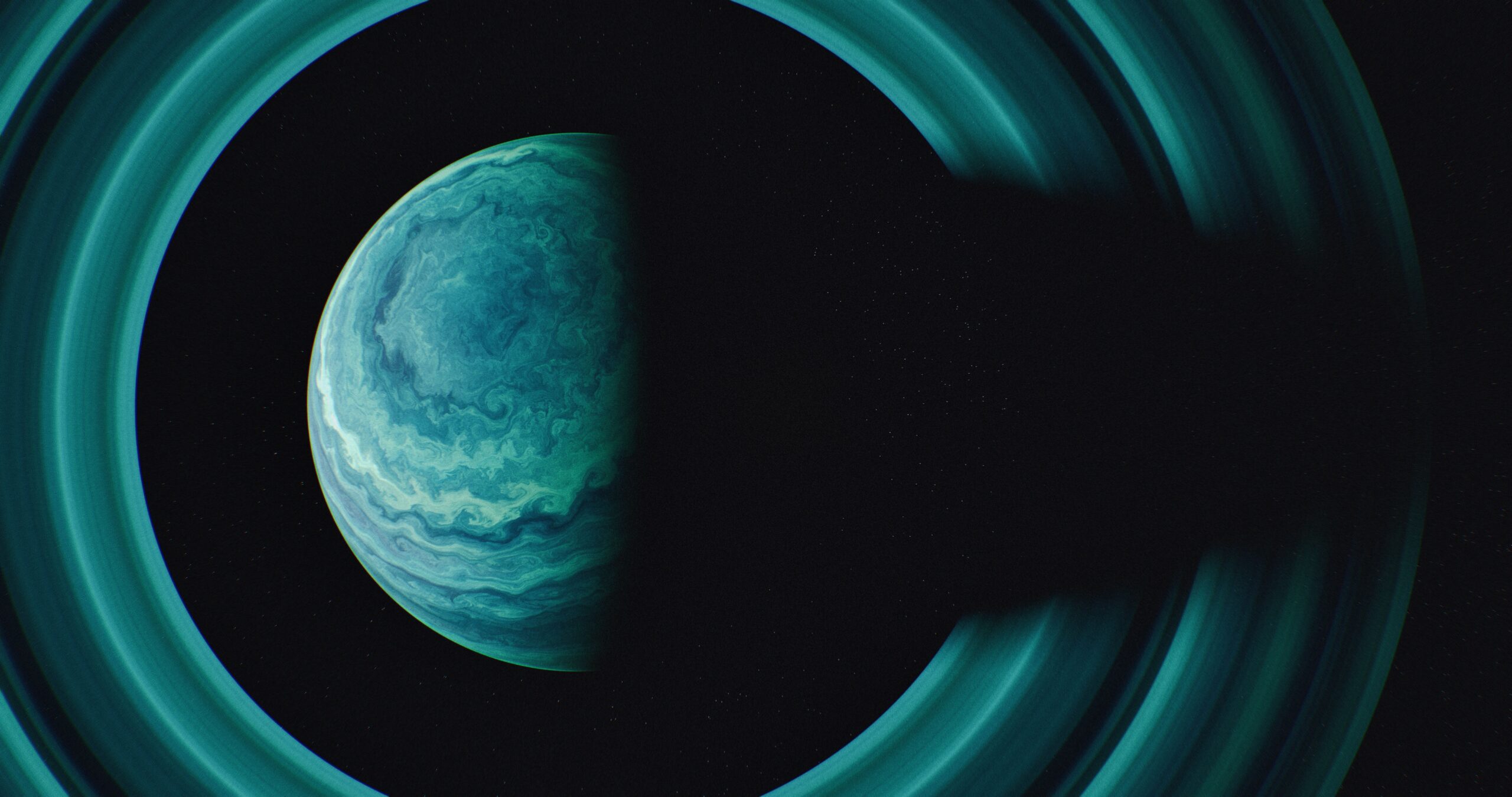
For nearly a century, cosmologists have leaned on a convenient assumption: zoom out far enough, and the universe looks roughly the same everywhere, with no special direction and no special place. This idea, known as the Cosmological Principle, is the quiet foundation underneath almost every model of how the cosmos formed and evolved. It does not demand a perfectly smooth universe up close, but it does demand that the lumps and voids average out once you look at a big enough patch of sky, generally estimated to happen at scales beyond roughly 370 million parsecs.
Astronomers Alexia M. Lopez and Roger G. Clowes have just described a structure that strains that assumption further than almost anything found before. In a new paper, they report the discovery of what they call “A Giant Ring on the Sky,” a ring-shaped arrangement of matter roughly 1.3 billion light-years across, sitting at a distance corresponding to a redshift of about 0.8.
The structure was not a lucky accident buried in the data. It was predicted before it was confirmed. The team had already mapped two other unusually large formations nearby, an elongated arc and a separate ring-like filament, and noticed that a smaller arc-shaped feature to the north looked like it might connect the dots into a single giant circle. When they looked closer with newer, more sensitive data, the ring appeared essentially where they expected it to be.
The method behind the discovery is almost as unusual as the result. Rather than photographing galaxies directly, Lopez and Clowes traced the structure using magnesium absorption lines imprinted on the light of distant quasars, extremely bright objects that act like cosmic flashlights shining through everything in between. When that light passes through a foreign gas cloud tied to a galaxy or a cluster, it leaves a very specific fingerprint in the spectrum. By mapping thousands of these fingerprints across the sky at the same distance, the researchers can reconstruct where matter is clumped, even in regions too faint to photograph well with ordinary telescopes.
The ring is not a subtle statistical wobble. Using a shape-matching technique that tests how well elliptical rings fit the data, the team found two overlapping candidate versions of the structure, both exceeding 4 standard deviations of significance, a threshold well above the level normally considered a firm detection in physics. A second, independent test, a two-dimensional power spectrum analysis that studies clustering across the whole patch of sky rather than one candidate shape at a time, found significant clustering on a physical scale of roughly 320 million parsecs, at a significance of 3.5 standard deviations.
Finding a convincing ring shape once is not proof that it is real. Pure chance can produce patterns that look meaningful if you search hard enough for them, a well-known statistical trap sometimes called the “look-elsewhere effect”: given enough random tries, something that resembles a discovery eventually turns up. So Lopez and Clowes ran the same tests on random datasets built to share the properties of their real field, and separately, on ten simulated patches of universe drawn from FLAMINGO-10K, one of the largest cosmological simulations built under the standard Lambda-CDM model. In four out of five random fields, the shape-matching test alone did manage to find a “statistically significant” ellipse, confirming the look-elsewhere risk is real. But when the power spectrum test was applied to those same random fields, and to every one of the ten simulated universes, none of them showed the kind of large-scale clustering seen in the real data. The random and simulated fields were indistinguishable from noise. The real field was not.
This is now the third unusually large structure the same research group has reported in this exact patch of sky and at this same cosmic distance, after an arc-shaped structure and a separate ring-like filament described in earlier papers. Having three of these formations overlapping in such a small volume raises the stakes, since a rare coincidence becomes harder to write off as one-off noise the more often it turns up in the same place. The researchers note that nested ring-like features are difficult to explain within the standard model of a smooth, uniformly expanding universe, and that a small number of independent theorists have floated more exotic explanations, including the idea that ripples imprinted by events in a hypothetical earlier phase of the universe’s history could still be leaving a mark today.
None of this settles the matter, and the authors are the first to say so. This is a single, still-developing line of evidence, not a closed case, and the same group’s earlier discoveries have already drawn published pushback from other cosmologists who argue similar-looking shapes can emerge from ordinary statistical flukes in large simulations. The paper explicitly frames the new ring as a preliminary analysis, and acknowledges that visually striking patterns are not automatically real physical structures, which is exactly why the power spectrum test carried so much weight rather than the shape-matching result alone. What keeps the case alive is that the very simulations used to challenge these findings, when tested the same way, failed to reproduce what shows up in the real sky.
Source: Alexia M. Lopez and Roger G. Clowes, “A Giant Ring on the Sky,” arXiv preprint arXiv:2604.17534 (submitted April 2026).