 Editorial NexoScience
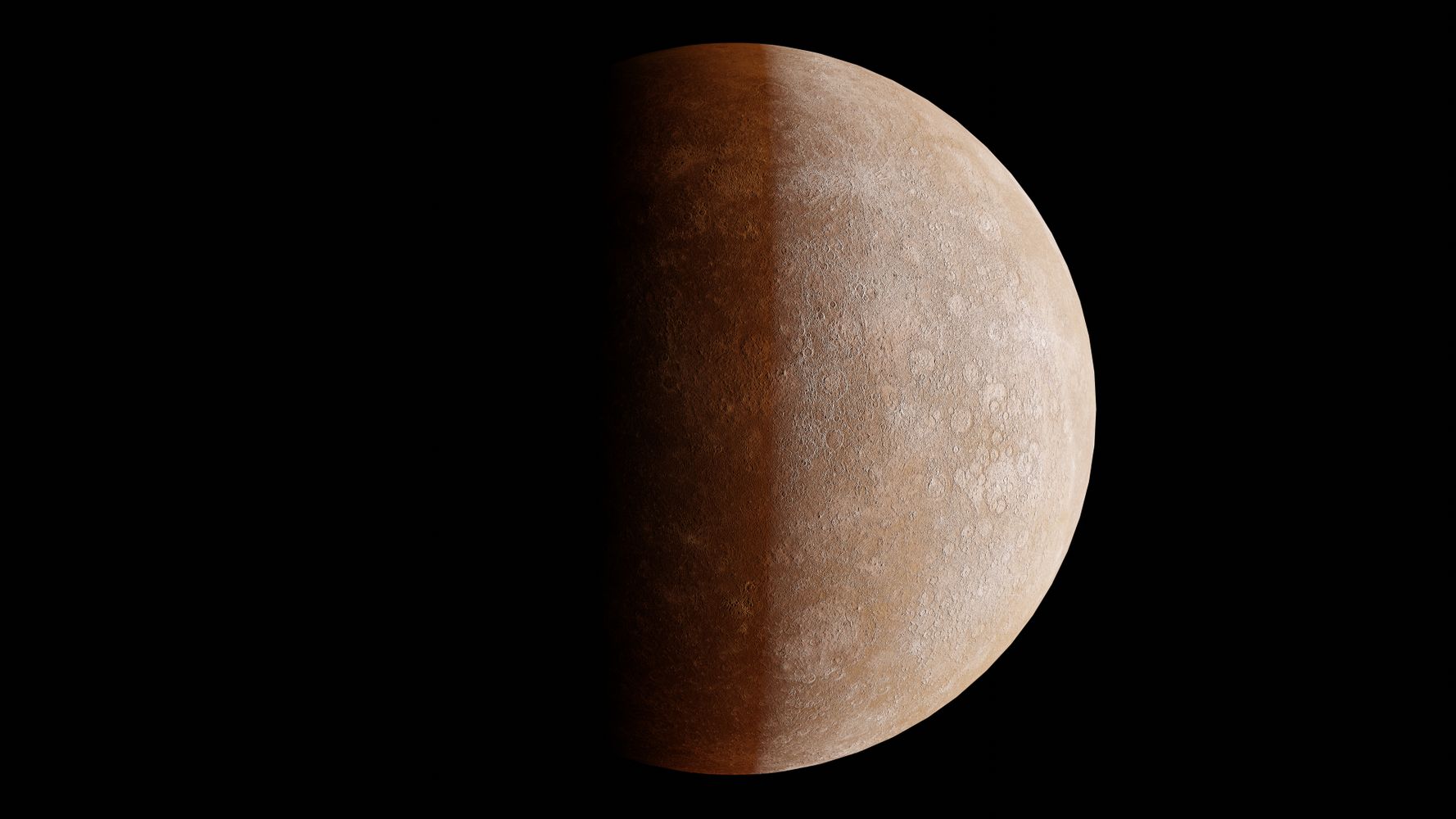
Leave an apple on the kitchen counter for a few weeks and its skin starts to wrinkle. The flesh inside dries out and shrinks, and the peel, with nowhere to go, buckles. Mercury has been doing something similar for about four billion years. As the planet’s interior cooled, it contracted, and the rocky crust on top cracked and shoved itself up into the long ridges and cliffs that still crisscross its surface.
The question is how much. Earlier studies of Mercury shrinking split into two camps: one concluded the planet’s radius fell by no more than about 1.2 miles (2 kilometers), the other put it close to 4.3 miles (7 km). A new analysis that used machine learning to measure tens of thousands of ridge segments lands near the top of that range. Mercury’s radius shrank by at least 3.9 miles (6.3 km), Adrien Broquet, of the University of Arizona’s Lunar and Planetary Laboratory and now at the German Aerospace Center’s Institute of Space Research in Berlin, and J. C. Andrews-Hanna, of the University of Arizona, reported in the Journal of Geophysical Research: Planets.
The fight is over the small ridges. Mercury’s shortening landforms come in a few flavors. Lobate scarps and high-relief ridges are the giants, often more than 0.6 mile (1 km) tall and running 60 to 600 miles (100 to 1,000 km). Wrinkle ridges are lower, shorter and wigglier, and they sit mostly on smooth volcanic plains. They also make up about 88% of the total mapped length. The low-estimate camp treats wrinkle ridges as shallow, local features with nothing to say about a planet-wide squeeze. Drop them, and the new analysis gets only about 0.75 mile (1.2 km) of contraction, matching that camp almost exactly. Keep them, and the number jumps.
A neural network learned where a ridge begins and ends. The team started from a recent catalog of 9,845 shortening landforms with a combined length of about 310,000 miles (500,000 km). They chopped every curving ridge into straight pieces, 53,085 in all, then pulled elevation profiles across each piece every 0.6 mile (1 km), reaching 43 miles (70 km) out on either side, and averaged them. That step filters out small craters and other clutter. The tricky part comes next. To know how tall a ridge is, you have to know where it starts and stops, and Mercury’s background terrain is anything but flat. So the researchers trained a neural network, a type of machine learning program that learns patterns from examples, on 88 profiles they had checked by eye. The network then marked the edges of every ridge on the planet. Its heights matched earlier hand measurements closely, the authors wrote.
The old shortcut came up short. Earlier studies measured a modest subset of ridges, worked out how tall a ridge tends to be for its length, and applied that ratio to the rest. The catch is that maps break long ridges into many short pieces, through erosion, crater hits or simply how they were drawn. A short piece of a big ridge still stands tall, but the ratio treats it as a small one. Measuring each ridge directly showed that the classic ratios underestimated the planet’s total strain by about 15% to 30%. Ridge height and length turned out to be only weakly linked, and the authors warn that such ratios should be applied to big catalogs “with caution, if at all.”
Some wrinkles are just echoes of a bigger fold. Picture shoving a tablecloth across a table. You get one big fold, plus a few small creases on its shoulders, all from the same push. Count each crease as its own fold and you overstate how hard you pushed. Mercury’s catalog has the same problem, so the team drew a 31-mile-wide (50 km) box around each ridge and kept only the longest one when several parallel ridges crowded together. Counting everything gives 5.2 miles (8.3 km) of contraction. The stricter count drops it to 3.9 miles (6.3 km), about 20% less. Honestly, that conservative number is the more striking one. Even with the doubles removed, the old cratered terrain alone records about 4.1 miles (6.6 km), far beyond the 0.75 mile you get by ignoring wrinkle ridges.
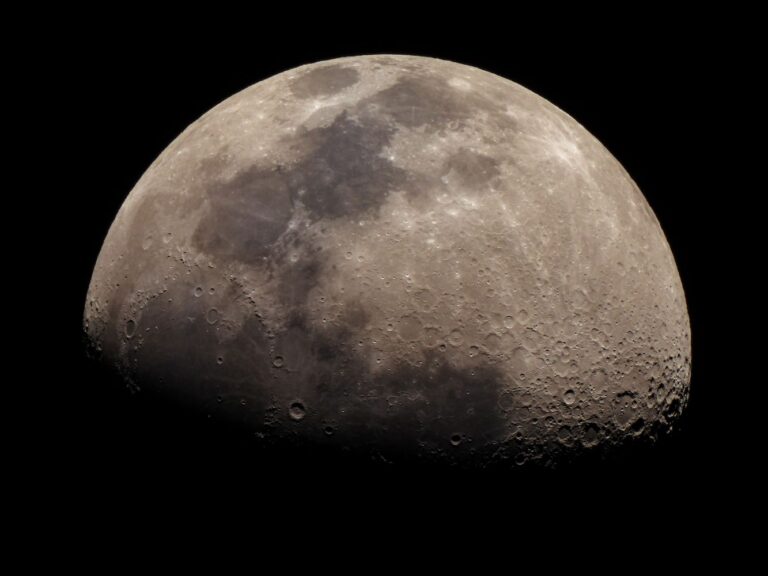
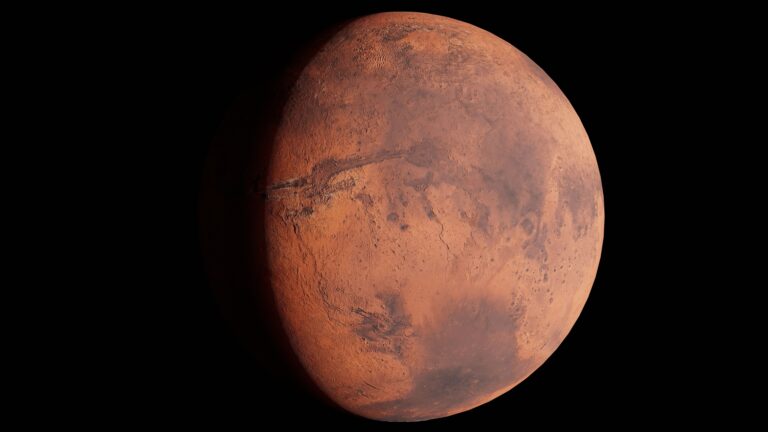
The young plains and the old highlands squeezed about the same. Wrinkle ridges pack the smooth plains much more densely than the cratered terrain, yet the strain recorded in both is similar. Sheer ridge count, it turns out, isn’t a good measure of how much the crust shortened. The map is patchy, though. North-south bands show crust shortened by nearly 1%, while zones east and west of the giant Caloris impact basin show almost none. Some of those quiet spots are simply younger basins that wiped out the older geology. Mercury’s wrinkle ridges also stand about 1,150 feet (350 meters) tall on average, compared with roughly 660 feet (200 m) on the moon and 330 feet (100 m) on Mars, which the authors suggest might reflect Mercury’s larger squeeze.
Most of the shrinking happened in a hurry. Older surfaces should hold more strain, because they have been around for more of the contraction. Using crater counts to date different patches of crust, the team found that Mercury’s radius dropped by about 2.5 miles (4 km) between roughly 4.1 billion and 4.0 billion years ago. That works out to about 130 feet (40 m) every million years. After that, the pace fell to roughly a quarter of that rate and then leveled off. Even the youngest surfaces record about 3.1 miles (5 km) of contraction since 3.7 billion years ago, but at an average rate more than ten times slower than in the early pulse. Mars shows a similar burst, the authors note, only later, between about 3.57 billion and 3.4 billion years ago.
A freezing iron heart may have hit the brakes. Here’s the thing: a cooling planet shouldn’t suddenly ease off. One explanation the authors raise is that Mercury’s solid inner core began to grow around then. When molten iron freezes onto a core, it gives off heat, and that extra heat would slow the cooling and the shrinking. Strong magnetic signatures of similar age preserved in the crust may support that timing. But this is an interpretation that fits the curve, not something the data prove, and the authors list other candidates, including bursts of volcanism and an early slowdown in the planet’s spin. The fast early contraction also clashes with some models that predict Mercury was still expanding until about 3.9 billion years ago.
The numbers carry real uncertainty. The elevation map the team used has pixels about 2,200 feet (665 m) wide, and that blurs ridges, making them look lower and wider than they are. For that reason, the authors write, all their estimates “should be regarded as lower bounds.” Some shrinking may also have been absorbed without faulting at all, for instance by squeezing pores in the crust. On the other side, the results lean on assumptions. Changing the assumed tilt of the faults beneath the ridges within a plausible range shifts the answer by about 20%, and changing the size of the area used to average strain moves it between 3.3 and 4.7 miles (5.3 and 7.6 km). The crater-based ages depend on which dating model you pick, which can differ by more than 200 million years, and surfaces older than about 4.05 billion or younger than 3.8 billion years are too rare for confident estimates. The method for removing duplicate ridges is purely geometric, not a detailed geological map.
A second paper and a bigger map are already in the works. In a companion study, the same authors use Mercury’s gravity and topography to test how the bending of its outer shell adds to or cancels the ridges’ story. They report that it reshapes the local picture without changing the global average. Meanwhile, a new catalog in development adds about 62,000 miles (100,000 km) of freshly identified ridges, mostly smaller ones, which the authors expect won’t change their conclusions. The real test may come from sharper elevation data, which would show whether Mercury’s wrinkles stand even taller than this blurred view allows.
Source: Broquet, A., & Andrews-Hanna, J. C. “Mercury’s tectonic and geodynamic history: 1. Contractional tectonic landform analysis and tectonic strain using machine learning.” Journal of Geophysical Research: Planets, 131, e2025JE009584 (2026). DOI: 10.1029/2025je009584