 Editorial NexoScience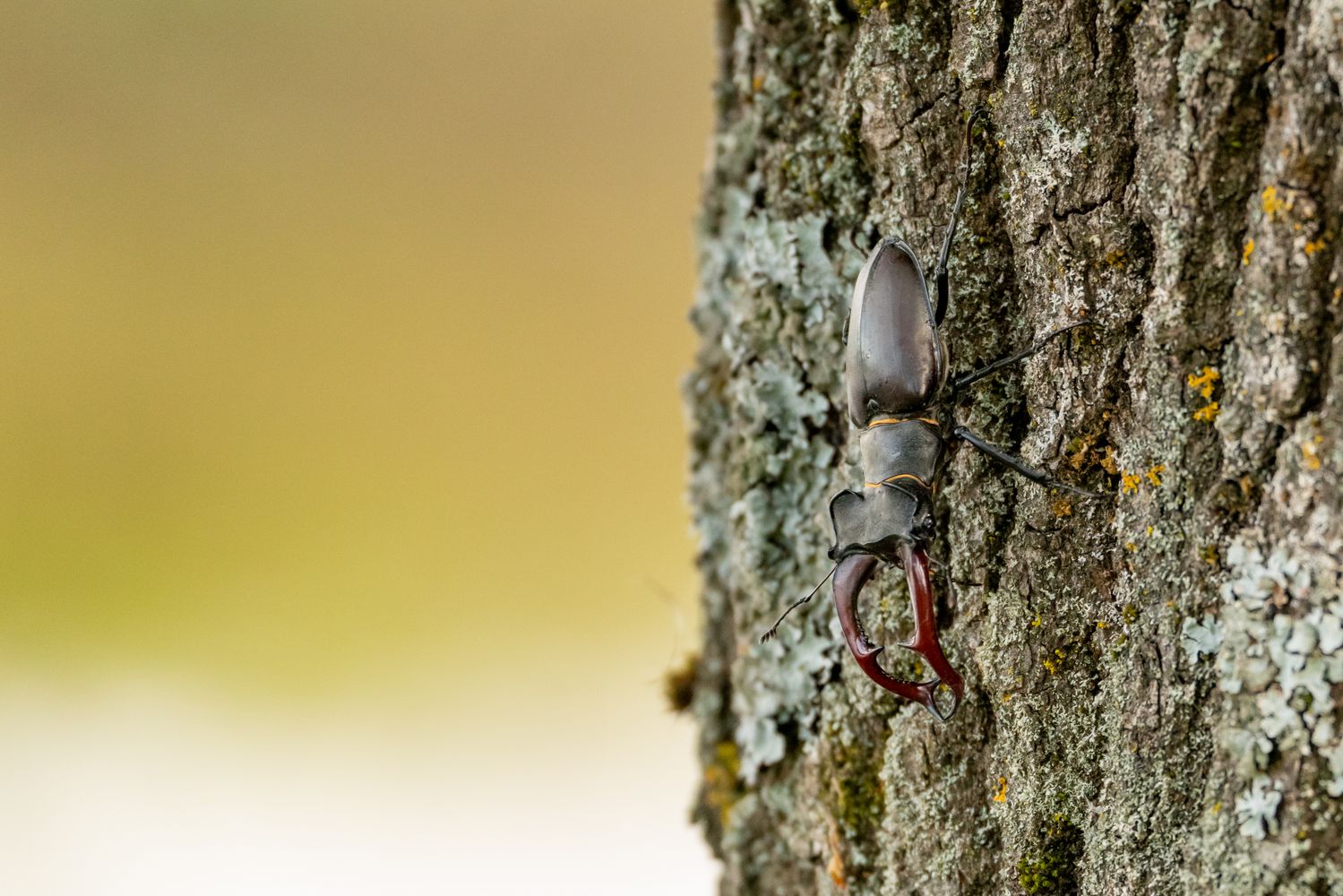
A male stag beetle’s mandibles can grow longer than its own body, curved into a pair of forceps built for one job: prying a rival off a tree trunk before he reaches a mate. On the Japanese mainland, that oversized weapon is the whole story of how these beetles compete. But travel south along the Izu Islands, a chain of small volcanic islands stretching into the Pacific off Tokyo, and the jaws quietly shrink with every island crossed, until on the southernmost island, Hachijo-jima, males carry a stubby, almost toy-sized version of the same structure.
A team of Japanese evolutionary biologists has now traced that shrinkage back to a single gene, and to what happens when an island population stops exchanging genes with the mainland. Researchers led by Kodai Kishino and Yasukazu Okada sequenced whole genomes from stag beetles across the mainland and the Izu Islands, then combined that data with population genetics and a hands-on lab experiment to test what was actually driving the pattern.
The islands closest to the mainland and the one farthest away turned out to have opposite genetic histories. On the intermediate islands, beetles kept mixing with mainland populations. Genetic tests estimated that roughly 36 percent of that mixed population’s genome traces back to recent gene flow from the mainland, and that steady influx appears to be diluting any local evolutionary drift toward smaller jaws. Hachijo-jima shows none of that mixing. Genomic dating placed its split from the mainland population at around 149,000 years ago, coinciding with when a nearby ocean current is thought to have shifted position and cut off migration. Once gene flow stopped, there was nothing left to erase whatever selection was doing on that island.
A single gene stood out when the researchers compared the isolated population’s genome against the rest. Scanning for regions that evolved differently only in Hachijo-jima turned up InR2, a gene involved in how insulin-like growth signals shape body parts as an insect develops. Hachijo-jima beetles carry two amino acid changes in InR2 not found anywhere else, and the DNA around that gene shows a textbook signature of a selective sweep, meaning much less genetic diversity than the rest of the genome in that exact stretch. To find out whether the gene actually causes the small jaws or is just riding along with something else, the team silenced InR2 in mainland beetle larvae using RNA interference. Males from that experiment grew significantly smaller mandibles, closely resembling the natural Hachijo-jima shape, in 13 treated larvae compared with 19 untreated controls.
Food appears to be the reason natural selection favored smaller jaws in the first place. Mainland stag beetles fight over sap oozing from oak tree trunks, a concentrated, defendable prize worth an oversized weapon. The Izu Islands never developed oak forests, and Hachijo-jima beetles instead rely on fallen mulberry fruit scattered across the forest floor, a resource too spread out to be worth guarding. The gene swap and the RNA interference results show a real causal link between InR2 and mandible size. The specific link to mulberry fruit and missing oak forests is the researchers’ best explanation for why that gene was favored, inferred from habitat differences rather than tested directly, and the authors are upfront about that distinction in their paper.
The findings come from Kishino K, Oikawa Y, Wakamiya T, et al., “Cessation of Gene Flow Associated With the Reduction of a Sexually Selected Phenotype in the Island Stag Beetle,” published in Molecular Ecology (2026), DOI: 10.1111/mec.70435.