 Editorial NexoScience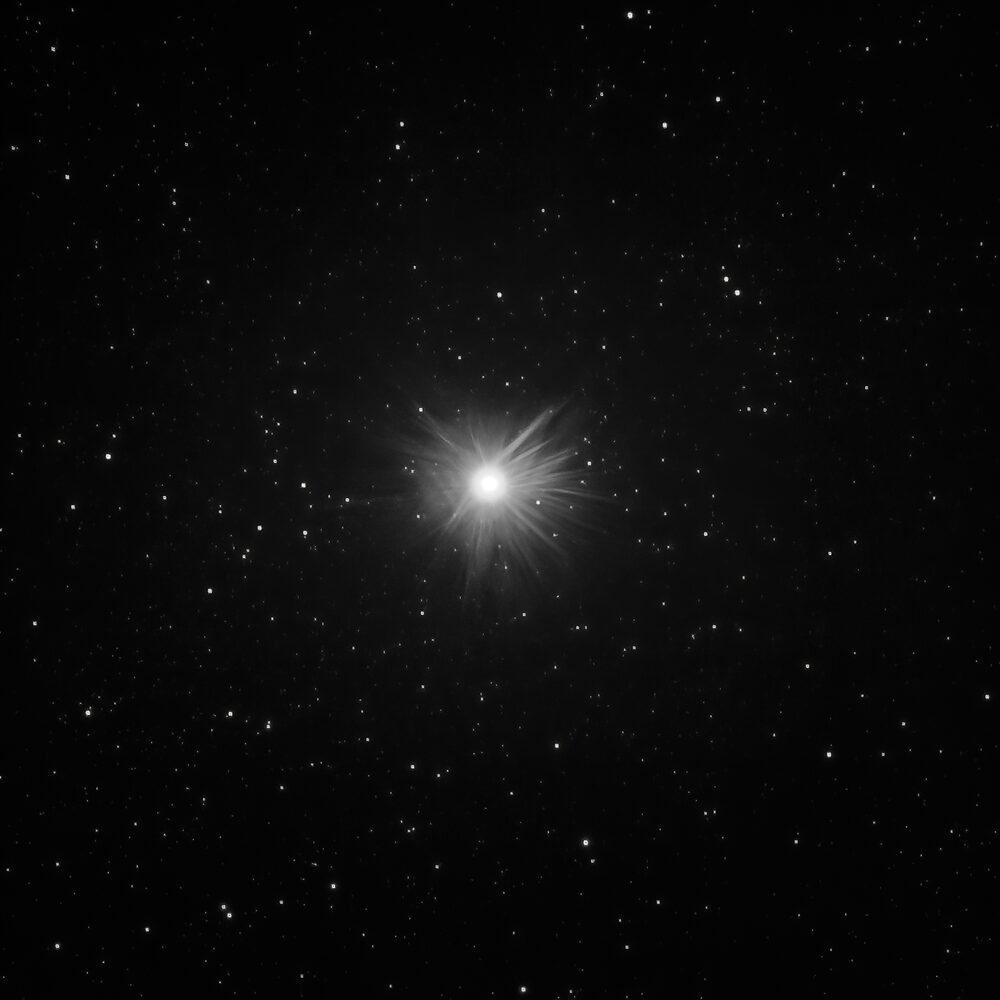
Twenty-seven years. That is how long a stellar corpse sat undetected practically on our cosmic doorstep, roughly 25 light-years from Earth, its light drowned out by a far brighter companion star sitting right next to it. Astronomers have now confirmed it is the ninth-closest white dwarf to the Sun, and it is not the only one that had gone unnoticed. A team has just directly detected four white dwarfs that were hiding in plain sight, tucked behind the glare of nearby red dwarf stars for years, sometimes decades.
A stellar corpse dressed up as an ordinary star. A white dwarf is what is left after a Sun-like star burns through its fuel: an Earth-sized ember packed with roughly the mass of a full star, cooling quietly over billions of years. When one forms in a tight orbit next to a smaller, brighter red dwarf, its faint light gets swamped almost completely, especially in the visible light astronomers usually rely on. The four systems in this study, cataloged as G 203-47, GJ 207.1, LHS 1817 and Wolf 1130, had all been flagged years or decades earlier as having some kind of invisible companion, based on how their visible star wobbled under gravity. Nobody had actually seen the white dwarf itself, until now.
Ultraviolet light is what gave them away. A team led by astrophysicist Mairi W. O’Brien, of the University of Warwick, pointed the Hubble Space Telescope’s Space Telescope Imaging Spectrograph at all four systems, hunting for near-ultraviolet light, the part of the spectrum where a cool white dwarf can still edge out the glare of its companion. Three of the four stars had never been observed this way before. The fourth, Wolf 1130, had been checked with Hubble back in 2003 and come up empty, its faint signal buried in the noise. This time, all four gave up their secret, with surface temperatures landing somewhere between roughly 5,300 and 6,300 Kelvin, cool enough, in stellar terms, to explain decades of staying quiet.
A simple brightness check would have gotten it wrong. The researchers also modeled the same four systems using nothing but broadband brightness measurements, the kind of data available for millions of stars without a dedicated spectrum, and compared the result against the direct detections. The brightness-only estimates ran 5 to 8 percent hotter than reality, mostly because flares and other activity from the red dwarf companions leak extra ultraviolet light into the mix and mimic a hotter white dwarf. It is a useful warning for anyone trying to spot similarly hidden stars without a space telescope on hand: a quick brightness estimate can point in the right direction, but it can also mislead.
One of the four refuses to behave like its neighbors. G 203-47 completes an orbit around its companion every 14.9 days, comfortably inside the range where these pairs are expected to have long since fallen into lockstep, with the same face of the star always pointing at its companion, much like the Moon does with Earth. Instead, the data point to a rotation period longer than 100 days, meaning the star is spinning far slower than a tidally locked one should. That hints at an unusual origin story: rather than being fully swallowed by its companion’s outer layers during a shared phase astronomers call a common envelope, as most tight pairs like this are thought to have been, G 203-47 may have only brushed through a much briefer version of the same process.
Four stars do not sound like much, but the numbers line up. Folding these four confirmed detections into the full census of white dwarfs within 20 parsecs of the Sun, the team recalculated the local density of both white dwarfs and pairs like these. The new estimate lines up well with predictions from BPASS, a widely used model of how pairs of stars evolve together, which forecast roughly four such systems in the same volume of space. It is a small but real vote of confidence in how well astronomers currently understand the long, messy process of two stars aging side by side.
An ultraviolet excess is a reliable sign of a hidden white dwarf companion, but the authors are upfront that plenty of similarly faint or cool ones could still be missing from the local count entirely, simply too dim even for Hubble to catch under a brighter companion’s glare. The findings come from O’Brien et al., “Direct detections of white dwarfs in four WD+dM post-common envelope binaries within 20 pc,” published in Monthly Notices of the Royal Astronomical Society, DOI 10.1093/mnras/stag1195.