 Editorial NexoScience
A hole about as wide as a fingertip doesn’t sound like much of a story. This one goes clean through a shoulder blade that has been in the ground for roughly 75,000 years. Its edges are smooth, its outline is almost a perfect circle, and cracks fan out from it like the lines on a broken windshield. Bones rarely say how someone died. This one comes close.
The shoulder blade belonged to a Neanderthal now called Shanidar A, an older adult whose remains were dug out of Shanidar Cave in Iraqi Kurdistan in 2019 and 2022. Emma Pomeroy and her colleagues reported in the journal Scientific Reports that the hole most likely came from a spear, and probably a wooden one, driven into this person around the time of death. The same skeleton carries signs of an earlier injury to the mouth that the individual survived for some time. And the body was laid down in a spot where other Neanderthals were placed, one after another, which makes this Shanidar Cave Neanderthal part of one of the most debated burial sites in human evolution.
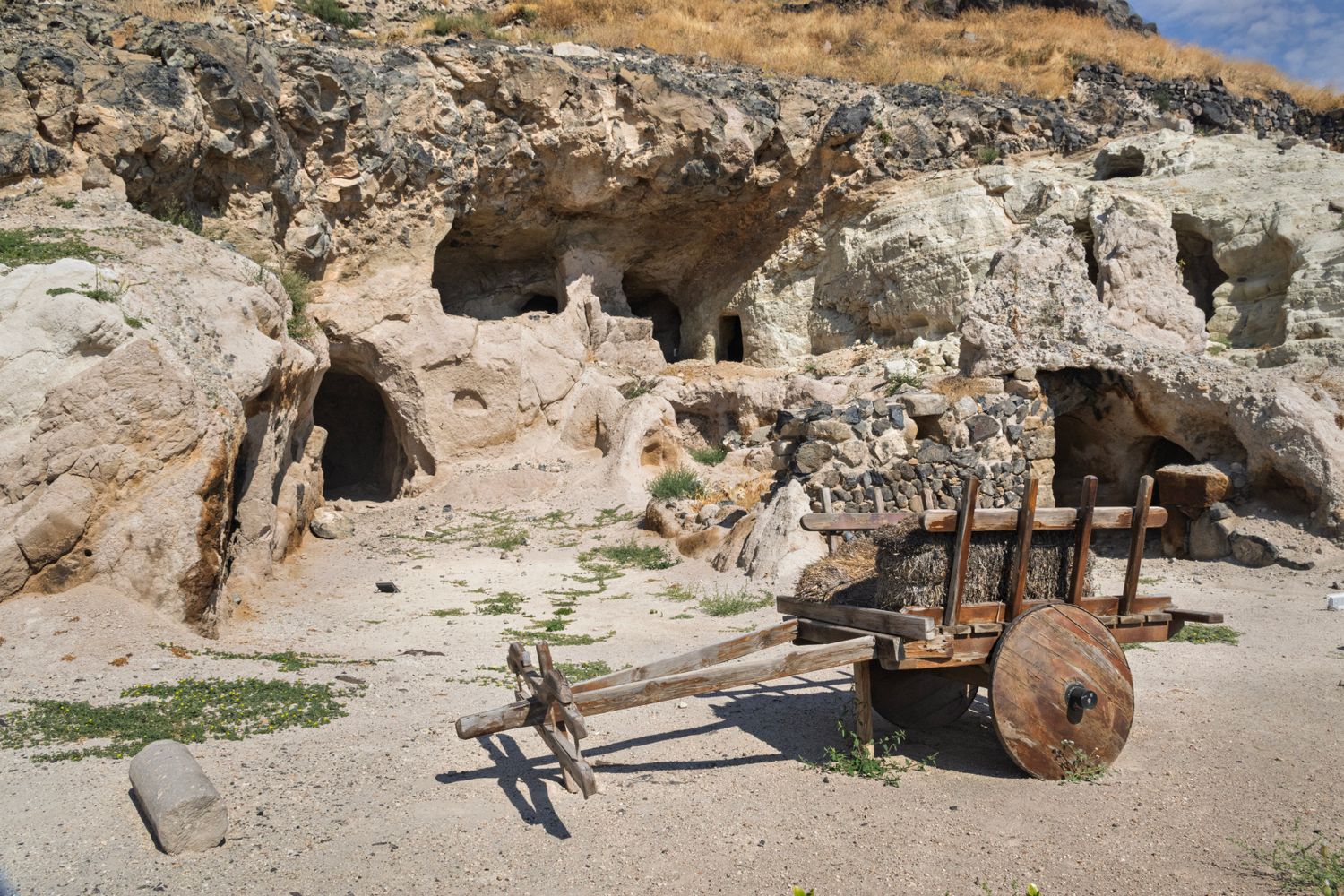
The cave already had a reputation. In 1960, Ralph Solecki’s team found a tight cluster of Neanderthal remains there, including the individual known as Shanidar 4, the famous “flower burial.” The idea that mourners had scattered flowers over the body has since been heavily criticized and hasn’t held up. New excavations that began in 2015 turned up more people right next to the old finds. With Shanidar A, the cluster now holds at least five individuals, packed into a space about 5 feet long, 3 feet wide and 3 feet deep (1.5 by 1 by 1 meters). That’s not much bigger than a bathtub. All of them lay directly behind a large boulder that had fallen from the cave roof and would have stood out above the floor like a marker.
Shanidar A was the first one in. The bones sat about 6 inches (150 millimeters) beneath the chest of another Neanderthal, Shanidar Z, and were the earliest in the sequence. What survived is partial: a mostly complete right hand, three ribs, the left shoulder blade and six heavily worn front teeth. A seventh tooth, a molar with far less wear, lay underneath the shoulder blade and probably came from someone else. The worn teeth suggest an age of about 45, old by Neanderthal standards. Sex couldn’t be estimated from the pieces that survived.
A flash flood shuffled the evidence. The body was placed in a shallow, dry channel and partly covered by sediment soon afterward. Long after the flesh had gone, a fast, stony flood tore through and flushed away most of the skeleton. The hand survived because the boulder shielded it. The loose front teeth were swept along until they jammed against the ribs, the way driftwood piles up against a rock. Here’s the thing: that log-jam is part of why the authors think the teeth and the bones belong to the same person. The researchers found no gnaw marks from carnivores, no rodent damage and no cut marks.
The hole isn’t a burrow or a root. The team lifted the shoulder blade out in a single block with the sand beneath it and scanned it with micro-computed tomography, a high-resolution form of CT that builds 3D images of tiny structures. No insect tunnels or plant roots of the right size passed through the hole. Its edges carry the same mineral stains as the rest of the bone, so it isn’t recent damage. And there’s no trace of healing, no new bone growing around the rim. Whatever made it happened around the time of death or afterward.
The bone broke from front to back. On the back face of the shoulder blade, the edge of the hole is bevelled, which is the classic sign of an exit wound. The cracks radiating outward are typical of bone that was still fresh when it broke. Under the hole, buried in the sand, the scans picked out at least four small bone chips. One of them slots straight back into the gap, confirmed by a faint muscle ridge that runs from the blade onto the chip. The authors conclude that a weapon entered the left side of the chest while the person faced forward. It would have gone through the lungs and possibly major blood vessels, and death likely came fast.
The round shape points to wood. In experiments, stone-tipped weapons tend to leave oval or diamond-shaped holes with narrow edges. A spear with a rounded wooden tip leaves a circle, which is what Shanidar A shows. Very similar wounds turn up in the shoulder blades of animals hunted in the Stone Age, often read as a “heart shot” meant to bring prey down quickly. Wooden spears are known from Clacton-on-Sea in England and Schöningen in Germany, but wood almost never survives at sites like Shanidar. So this hole is rare, if indirect, evidence that Neanderthals there used wooden weapons. By contrast, a slicing wound on the rib of another Neanderthal from the cave, Shanidar 3, who lived about 25,000 years later, has been read as the work of a stone-tipped weapon.
Long before that, this person lived through a smashed mouth. One lower front tooth had split lengthwise, losing half of itself. Honestly, the most striking part is what happened next. The broken surface, and the faces around it, became coated in thick layers of dental tartar, or calculus, the hardened plaque that builds up on teeth. The biting edge kept getting worn and polished right through that crust. That means the shattered tooth stayed in the mouth and kept chewing for a long while. The injury probably also twisted neighboring incisors out of place. A hard blow to the face, from a fall onto rock or from another person, is a plausible cause, the authors wrote.
Someone probably looked after them. A wound that wrecks the front of the lower jaw would have made eating, talking and simply getting through the day painful for a long time. The researchers argue that recovering from it may have needed help from others, during healing and possibly beyond. It’s a quiet detail inside a violent story. And it fits a wider pattern: Neanderthals and early modern humans broke a lot of bones, and many of them survived.
The burial spot looks deliberate. The study argues the cluster wasn’t a group that huddled behind the boulder and froze together. The bodies went in on separate occasions, with layers of sediment between some of them, and pollen and soil evidence point to mild weather at the time. Several people were laid down before the previous body had fully decayed, so the whole cluster likely built up within generations. The repeated use of one small space, the authors wrote, is “difficult to explain except in terms of intentional patterned behaviour.” For Shanidar A, that suggests care during and right after death, too.
Plenty stays out of reach. The authors acknowledge that the bones could, in principle, come from more than one person. Whether the spear wound came from a hunting accident or from violence between individuals can’t be known, and violence between Neanderthal groups, or with modern humans, has never been demonstrated at Shanidar. The wooden spear itself is inferred from the shape of the wound, not found. Unlike Shanidar Z, Shanidar A shows no dug-out pit around the body. And the link between the facial injury and care from others is an interpretation, not something the bones record directly.
The next clues may be sitting in a museum. The 1960 remains are now in the Iraq Museum in Baghdad, and the team plans to check whether some of the newly found bones belong to individuals Solecki already described. Experiments in forensic taphonomy, the study of what happens to a body after death, are also testing whether a hole like this one needs a high-speed strike to form. If the answer is yes, the line between an accident and an attack at Shanidar could get a little sharper.
Source: Pomeroy, E., Hunt, C. O., López-Polín, L., Sala, N., Pantoja-Pérez, A., Holman, J., et al. “Evidence for funerary behaviour and lethal trauma in a new Neanderthal individual from Shanidar Cave.” Scientific Reports (2026). DOI: 10.1038/s41598-026-69193-z
This article summarizes published scientific research for general information. It is not medical advice and does not replace consultation with a qualified health professional.